

D'Artagnan (F1) Melon Seed
Quick Facts
-
Latin Name
-
Cucumis melo
-
Days To Maturity
Days To Maturity
Average number of days from seeding date to harvest, within a specific crop group. If a transplanted crop: average number of days from transplant date. Not sure if crop is direct-seeded or transplanted? Check the Growing Information box for details. If crop can be both direct-seeded or transplanted, days to maturity refers to direct seeding. Days to maturity for all flowers and herbs is calculated from seeding date.
×
-
71 days
-
Disease Resistance Codes
Disease Resistance Codes
- F
- Fusarium Wilt
- PM
- Powdery Mildew
-
F ,
PM
-
Hybrid Status
Hybrid Status
Hybrid: The offspring of a cross between two or more distinct parent lines, usually of same species, and selected for improved traits.
×
Open-pollinated: A non-hybrid variety that can reproduce itself in kind, demonstrating relatively stable traits from one generation to the next. -
Hybrid (F1)
D'Artagnan (F1) Melon Seed
Take advantage of our overstock position! Extra-early Charentais.
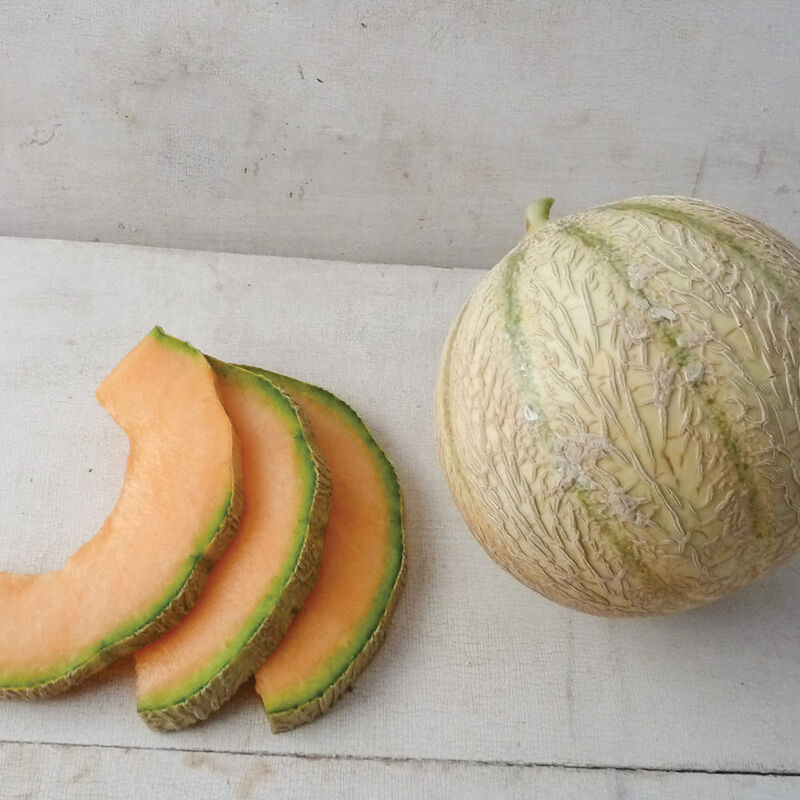
Matures a full week before Savor. Round to slightly oval fruits with green sutures and moderate netting average 2 lb. Rich dark orange flesh with traditional Charentais flavor—very sweet and aromatic. Cut from the vine when skin is green with a yellowish tinge.Disease Resistance:
Fusarium Wilt races 0–2 (Intermediate)
Specs:
Quick Facts
-
Latin Name
-
Cucumis melo
-
Days To Maturity
Days To Maturity
Average number of days from seeding date to harvest, within a specific crop group. If a transplanted crop: average number of days from transplant date. Not sure if crop is direct-seeded or transplanted? Check the Growing Information box for details. If crop can be both direct-seeded or transplanted, days to maturity refers to direct seeding. Days to maturity for all flowers and herbs is calculated from seeding date.
×
-
71 days
-
Disease Resistance Codes
Disease Resistance Codes
- F
- Fusarium Wilt
- PM
- Powdery Mildew
-
F ,
PM
-
Hybrid Status
Hybrid Status
Hybrid: The offspring of a cross between two or more distinct parent lines, usually of same species, and selected for improved traits.
×
Open-pollinated: A non-hybrid variety that can reproduce itself in kind, demonstrating relatively stable traits from one generation to the next. -
Hybrid (F1)
- This product does not ship to the following countries: United Arab Emirates, Austria, Australia, Barbados, Belgium, Bulgaria, Bermuda, Bahamas, Switzerland, Cyprus, Czech Republic, Germany, Denmark, Estonia, Spain, Finland, France, United Kingdom, Greece, Hong Kong, Croatia, Hungary, Ireland, Iceland, Italy, Japan, Republic of Korea, Kuwait, Cayman Islands, Lithuania, Luxembourg, Latvia, Malta, Netherlands, Norway, New Zealand, Oman, Poland, Portugal, Qatar, Romania, Saudi Arabia, Sweden, Singapore, Slovenia, Slovakia, San Marino, Thailand, Trinidad and Tobago, Taiwan, Ukraine.
SCIENTIFIC NAME:
Cucumis meloCULTURE:
A light, well-drained soil with a pH of 7.0 and a southern exposure is ideal. Good soil moisture is important in early stages of growth and during pollination when fruits are setting. Limit water the last week before fruit are ripe, as overwatering can cause bland fruit. Since melons like consistently warm conditions, plastic mulch and row covers will make for earlier crops and better yields, especially in the North. Remove covers when plants have female flowers (identified by the tiny fruit at base of blossom).DAYS TO MATURITY:
From transplanting; add about 10 days if direct-seeded.TRANSPLANTING:
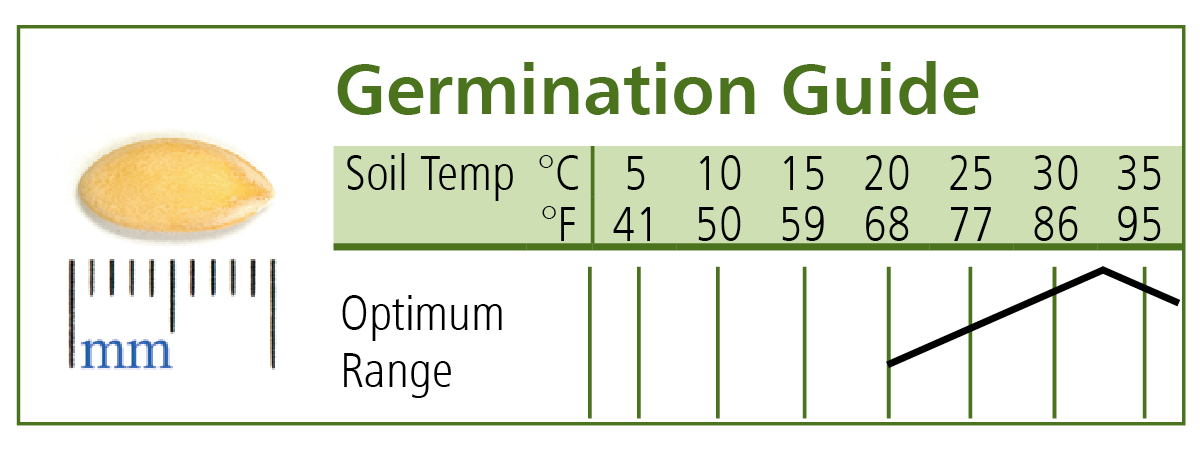
Sow indoors in 50-cell plug trays or 2-3" biodegradable pots in late April or one month (no sooner!) before transplanting outdoors. Plant 1-2 seeds per cell or pot, about 1/4" deep. Keep temperature 80-90°F (27-32°C) until germination. Thin to 1 seed per cell. Handle young plants carefully and never let the soil dry out. Grow seedlings at 75°F (24°C). Reduce water and temperature for a week to harden off seedlings. When the weather is frost-free, warm, and settled, transplant 2-3' apart in rows 6' apart or thin to 1 plant/cell or pot with scissors and transplant 18" apart. Even hardened off melon seedlings are tender. Do not disturb roots when transplanting, and water thoroughly.DIRECT SEEDING:
Sow 1-2 weeks after last frost when soil is warm, above 70°F (21°C), 2-3 seeds every 18", 1/2" deep, thinning to 1 plant.AVG. DIRECT SEEDING RATE:
30 seeds/10', 100 seeds/50', 1M/500', 15M/acre at 3 seeds every 18" in rows 6' apart.INSECT PESTS:
Protect against cucumber beetles with floating row covers applied at transplanting, or with insecticides such as pyrethrin or azadirachtin.DISEASE: Choose varieties resistant to diseases in your area. Sudden wilt (which is caused by cold weather stress in late summer when plants have a heavy set of ripening melons), can cause plants to wilt almost overnight. Keep plants healthy with good fertility and irrigation to prevent sudden wilt.HARVEST:
Watch for indicators such as: a change in skin coloration; checking or striations; slight softening of fruit; browning/shriveling of tendril and/or leaf proximal to fruit stem; and shrinking/cracking at stem attachment. At harvest, there are 3 general categories of melon: "Full Slip", where a light tug separates fruit from vine; "Forced Slip", where more pressure is needed to separate fruit from vine; and "No Slip", which must be cut from the vine. For a more detailed explanation of melon types and their harvest indicators, see our online Grower's Library.STORAGE:
Store ripe netted melons at 36–41°F (2–5°C) and 90–95% humidity. Store other types at 45–50°F (7–10°C) and 85–95% humidity. All will hold for a few days without refrigeration, but will hold longer if chilled. The particular variety and the ripeness of the fruit at harvest will dictate the duration of storage.SEEDS/LB. (AVG.):
18,800.PACKET:
30 seeds, unless otherwise indicated.Johnny's is committed to your success, every step of the way.
We want you, our customer, to be 100% satisfied with all of our seeds, tools, and supplies.
If anything you purchase from us proves unsatisfactory, we will either replace the item or refund the purchase price.