

Napoli Organic (F1) Carrot Seed
Quick Facts
-
Latin Name
-
Daucus carota var. sativus
-
Days To Maturity
Days To Maturity
Average number of days from seeding date to harvest, within a specific crop group. If a transplanted crop: average number of days from transplant date. Not sure if crop is direct-seeded or transplanted? Check the Growing Information box for details. If crop can be both direct-seeded or transplanted, days to maturity refers to direct seeding. Days to maturity for all flowers and herbs is calculated from seeding date.
×
-
58 summer sowing
-
Life Cycle
Life Cycle
Plants can be Annuals (single growing season), Perennials (grow year after year), Tender Perennials (grow year after year in warmer climates; and in some cases when given special protection in colder climates), or Biennials (require two years to mature).
× -
Annual
-
Hybrid Status
Hybrid Status
Hybrid: The offspring of a cross between two or more distinct parent lines, usually of same species, and selected for improved traits.
×
Open-pollinated: A non-hybrid variety that can reproduce itself in kind, demonstrating relatively stable traits from one generation to the next. -
Hybrid (F1)
-
Product Features
Product Features
-
 Organic Seeds, Plants, and Supplies
-
Plants, or seeds harvested from plants, that have been grown without synthetic fertilizers or pesticides, strictly adhering to the USDA's National Organic Standards Board (NOSB) organic gardening practices are designated as Organic.
Supplies that meet the USDA's National Organic Program (NOP) rules according to a third-party authority such as OMRI, WSDA, and/or a local authority such as MOFGA or NOFA.
-
-
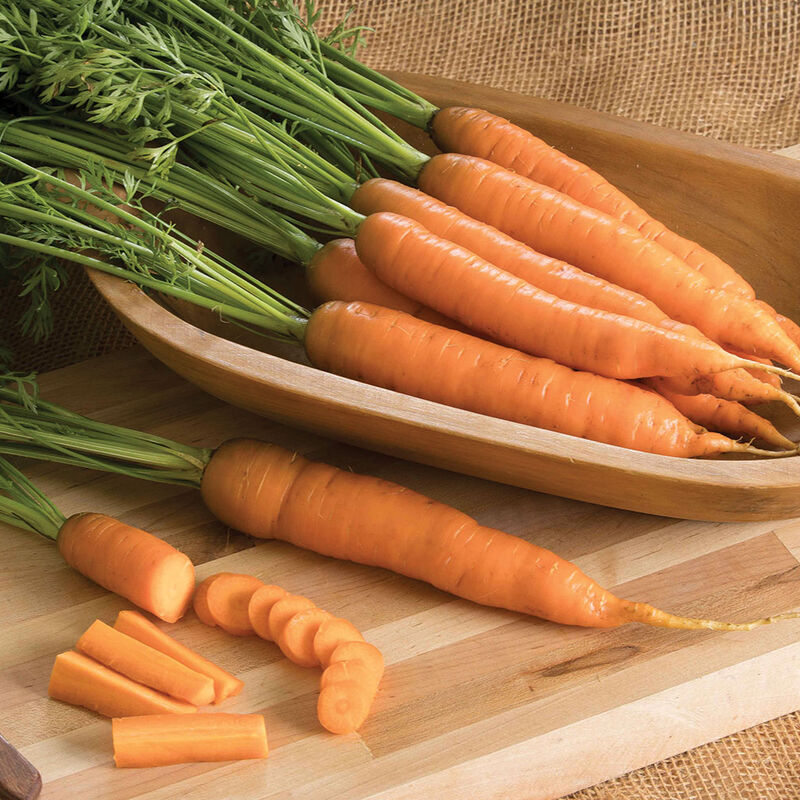
Napoli Organic (F1) Carrot Seed
Ideal for overwintering.
A specialized variety with a sweet taste when sown in fall for winter harvest. In cold regions sow in the greenhouse. In mild regions sow outdoors in the open or protected with fabric row cover. Overwintered crops will take longer to reach maturity. Up to 7" long, bulky, semi-blunt roots with strong tops. Early Nantes type. Also available with NOP-compliant pelleting. USDA Certified Organic.Specs:
Quick Facts
-
Latin Name
-
Daucus carota var. sativus
-
Days To Maturity
Days To Maturity
Average number of days from seeding date to harvest, within a specific crop group. If a transplanted crop: average number of days from transplant date. Not sure if crop is direct-seeded or transplanted? Check the Growing Information box for details. If crop can be both direct-seeded or transplanted, days to maturity refers to direct seeding. Days to maturity for all flowers and herbs is calculated from seeding date.
×
-
58 summer sowing
-
Life Cycle
Life Cycle
Plants can be Annuals (single growing season), Perennials (grow year after year), Tender Perennials (grow year after year in warmer climates; and in some cases when given special protection in colder climates), or Biennials (require two years to mature).
× -
Annual
-
Hybrid Status
Hybrid Status
Hybrid: The offspring of a cross between two or more distinct parent lines, usually of same species, and selected for improved traits.
×
Open-pollinated: A non-hybrid variety that can reproduce itself in kind, demonstrating relatively stable traits from one generation to the next. -
Hybrid (F1)
-
Product Features
Product Features
-
Organic Seeds, Plants, and Supplies
-
Plants, or seeds harvested from plants, that have been grown without synthetic fertilizers or pesticides, strictly adhering to the USDA's National Organic Standards Board (NOSB) organic gardening practices are designated as Organic.
Supplies that meet the USDA's National Organic Program (NOP) rules according to a third-party authority such as OMRI, WSDA, and/or a local authority such as MOFGA or NOFA.
-
-
- This product does not ship to the following countries: United Arab Emirates, Austria, Australia, Barbados, Belgium, Bulgaria, Bermuda, Bahamas, Switzerland, Cyprus, Czech Republic, Germany, Denmark, Estonia, Spain, Finland, France, United Kingdom, Greece, Hong Kong, Croatia, Hungary, Ireland, Iceland, Italy, Japan, Republic of Korea, Kuwait, Cayman Islands, Lithuania, Luxembourg, Latvia, Malta, Netherlands, Norway, New Zealand, Oman, Poland, Portugal, Qatar, Romania, Saudi Arabia, Sweden, Singapore, Slovenia, Slovakia, San Marino, Thailand, Trinidad and Tobago, Taiwan, Ukraine.
SCIENTIFIC NAME:
Daucus carota var. sativusCULTURE:
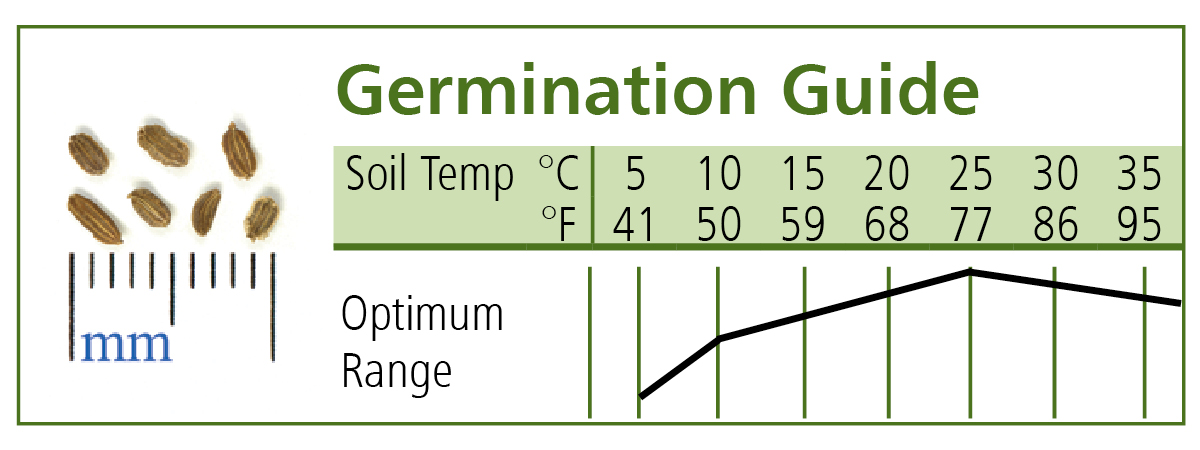
Carrots require well-drained soils, with a pH range of 6.0-6.8. Deep, loose, and fertile sandy loams and peat soils with good moisture-holding capacity grow the straightest and smoothest roots.DAYS TO MATURITY: From date of direct seeding.DIRECT SEEDING: Sow from early spring to midsummer, 3/4–1" apart, 1/4– 1/2" deep, in a 2"-wide band (about 30 seeds/ft.), or single rows 16–24" apart. For minimum soil compaction, use raised beds with 2 or 3 rows 16–24" apart, beds 5–6' on center. Sprinkle the soil surface to keep moist. Do not allow soil to crust before the emergence of seedlings, which takes 1–3 weeks, depending on temperature and moisture. If necessary, thin young seedlings to 3/4–2" apart, depending on root size desired. Keep weed-free by tine weeding and shallow hoeing. To prevent greening, cover exposed crowns.AVG. DIRECT SEEDING RATE:
1 M/33', 5M/166', 25M/830', 720M/acre at 30 seeds/ft. in rows 24" apart.INSECT PESTS:
Carrot rust flies and wireworms: Provide fertile growing conditions and avoid ground recently in sod if possible. Exclude adult insects with fabric row covers.DISEASE: Blights can reduce yield and quality. Alternaria blight shows as brown-black lesions edged with yellow on leaf margins beginning on oldest leaves. Leaflets may shrivel and die. Cercospora blight first appears as small dark spots with yellow margins on the younger leaves and stems. To prevent blights, practice a 3-year crop rotation. Copper fungicides can also be employed.HARVEST:
Carrots may be dug any time after they reach the desired size. Generally the best harvest period lasts about 3 weeks (longer in cool, fall weather), after which time the roots may crack or the taste and appearance may decline. Make a few sowings at 3-week intervals for a continuous supply of tender carrots at their prime.STORAGE:
Plant carrots intended for winter storage about 100 days before expected fall frost. Carrots store best at 32°F (0°C) and 98% relative humidity.CARROT TYPES:
Each type is identified in product description. Amsterdam are short-season, medium-to-small, and cylindrical. Nantes are medium-length and cylindrical. The Shipping/Imperator types have the extra length and durability required of conventional packaged carrots, and perform best in deeply worked soil. Chantenays are top-shaped and suitable for shallow or heavy soil. Kuroda types have thick, tapered roots and can be darker than average in color. They are suitable for subtropical winter production (CA, TX, FL) or temperate summer production, where winters get below 45–50°F (7–13°C).SIZED SEEDS:
"Sized" seeds have been sorted so they are roughly the same size. This consistency allows for more accurate spacing with mechanical seeders and more even germination. Carrot seeds are sized, except when noted in the product description.SEEDS/LB.:
204,000–436,100 (avg. 294,900).PACKET:
750 seeds, sows 25'.Johnny's is committed to your success, every step of the way.
We want you, our customer, to be 100% satisfied with all of our seeds, tools, and supplies.
If anything you purchase from us proves unsatisfactory, we will either replace the item or refund the purchase price.