

About Pelleted Seeds
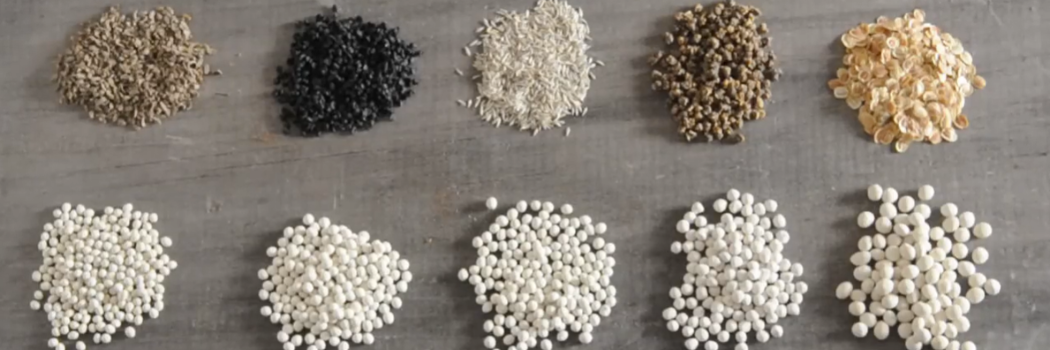
Pelleting is the process by which seeds that are small or irregularly shaped are coated with inert materials to render them uniform in size, shape, and weight. Seeds are pelleted by tumbling them with the coating materials and gradually adding moisture. Once the pellet coating reaches the desired size, the pelleted seeds are cured (dried).
Pelleted seed offers both advantages and limitations; with attention to the following, however, its full benefits can be readily achieved.
Benefits Of Pelleted Seed
Whether direct-seeded in the field or sown into flats, plugs, or soil blocks for transplants, pelleted seed allows for a more efficient seeding process. Seed uniformity is particularly important for successful sowing with mechanical seeders. Because of its uniform size and shape, pelleted seed is less prone to sticking or jamming in the seeders. This allows growers to accurately singulate seeds, resulting in less seed waste and time spent thinning. With root and bulb crops such as onions, beets, carrots, and parsnips, the even spacing can favor more uniform roots.
More generally, pellets make seed handling easier for small-seeded crops such as lettuce, carrots, and some flowers, so even if you are not planting on a large scale, pellets offer convenience and efficiency.
Selecting Pelleted Seed
Pellet Size
Pellets come in various sizes and densities. Johnny’s offers medium-density pellets that are useful in a diversity of growing conditions and planting equipment. Pellet size refers to diameter, given in units of 1/64 of one inch. For example, the diameter of a size 13.0 pellet is 13.0 x 1 /64", which is approximately 0.2".
Growers use a wide range of mechanical seeders that are fitted with interchangeable plates, rollers, and belts corresponding to specific pellet sizes. Visit the Seeders section of our Tools & Supplies Library for charts that match roller and plate part numbers to crop and pellet sizes.
Knowing the size of your pellet and matching it with the appropriately sized plate, belt, or roller in your mechanical seeder is essential. Using this equipment with the incorrect sizing can result in either poor singulation or crushed pellets.
Seed-Pelleting Options & Combinations
In addition, Johnny’s offers several seed-pelleting combinations to provide growers with options:
- Conventional seed with conventional pelleting. Part numbers suffixed with P.
- Conventional seed with NOP-compliant pelleting. Part number suffixed with JP.
- Certified-organic seed with NOP-compliant pelleting. Part number suffixed with GP.
Cultural Considerations
Pelleted seed also requires some extra attention after sowing, as it performs best when given consistent, moderate soil moisture throughout the germination period.
An initial watering may split or dissolve the pellet, whereupon the soil or planting medium should not be allowed to dry out before germination is complete, as it can result in only partial splitting of the pellet, stunting or killing the germinating seed.
Be mindful not to over-water, either, as waterlogged conditions can also hinder successful germination of pelleted seed. If the coating of fine, absorptive minerals becomes saturated, it can prevent adequate gaseous exchange (respiration) for survival of the germinating embryo within.
Shelf Life & Storage Of Pelleted Seed
While pelleting offers many advantages, the process and nature of pelleting may shorten the shelf life of the seed. We recommend using pelleted seed within one year of purchase. If you need to store pelleted seeds until planting, protect them from heat and humidity in a cool, dark, dry place. If you prefer to store your seed in the refrigerator, place the seed in an air-tight container to protect it from fluctuations in humidity.