

Bolero Pelleted (F1) Carrot Seed

Quick Facts
-
Latin Name
-
Daucus carota var. sativus
-
Days To Maturity
Days To Maturity
Average number of days from seeding date to harvest, within a specific crop group. If a transplanted crop: average number of days from transplant date. Not sure if crop is direct-seeded or transplanted? Check the Growing Information box for details. If crop can be both direct-seeded or transplanted, days to maturity refers to direct seeding. Days to maturity for all flowers and herbs is calculated from seeding date.
×
-
75 days
-
Life Cycle
Life Cycle
Plants can be Annuals (single growing season), Perennials (grow year after year), Tender Perennials (grow year after year in warmer climates; and in some cases when given special protection in colder climates), or Biennials (require two years to mature).
× -
Annual
-
Disease Resistance Codes
Disease Resistance Codes
- BB
- Bacterial Blight
- CS
- Cavity Spot
- AB
- Alternaria Blight
- C
- Cold (Sub-optimum temperature)
- PM
- Powdery Mildew
-
BB ,
CS ,
AB ,
C ,
PM
-
Hybrid Status
Hybrid Status
Hybrid: The offspring of a cross between two or more distinct parent lines, usually of same species, and selected for improved traits.
×
Open-pollinated: A non-hybrid variety that can reproduce itself in kind, demonstrating relatively stable traits from one generation to the next. -
Hybrid (F1)
-
Product Features
Product Features
-
 Easy Choice
- Variety is easy-to-grow.
-
-
Bolero Pelleted (F1) Carrot Seed
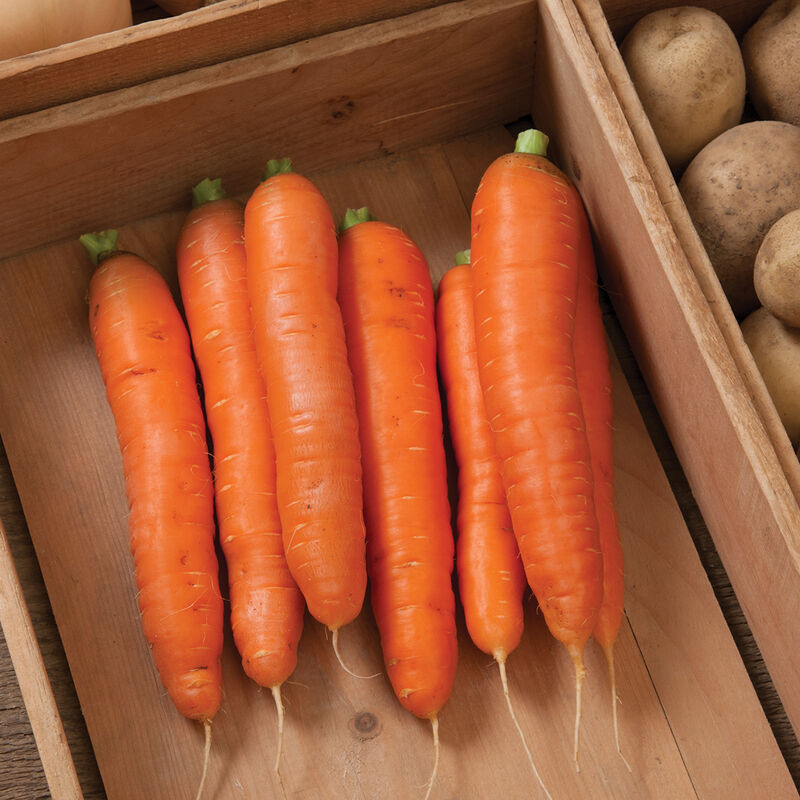
Reliable storage carrot. Conventional seed with NOP-compliant pelleting.
Medium-long 7–8" roots are uniform, thick, slightly tapered, and blunt. Excellent eating quality both fresh and after long-term storage, with juicy texture and sweet, complex flavor. A great choice for fall and winter harvest. Tops are vigorous, fast, and healthy which makes for better field-holding ability and easier mechanical harvesting. Heavy Nantes type.Disease Resistance:
Alternaria Blight (High)
Specs:
Quick Facts
-
Latin Name
-
Daucus carota var. sativus
-
Days To Maturity
Days To Maturity
Average number of days from seeding date to harvest, within a specific crop group. If a transplanted crop: average number of days from transplant date. Not sure if crop is direct-seeded or transplanted? Check the Growing Information box for details. If crop can be both direct-seeded or transplanted, days to maturity refers to direct seeding. Days to maturity for all flowers and herbs is calculated from seeding date.
×
-
75 days
-
Life Cycle
Life Cycle
Plants can be Annuals (single growing season), Perennials (grow year after year), Tender Perennials (grow year after year in warmer climates; and in some cases when given special protection in colder climates), or Biennials (require two years to mature).
× -
Annual
-
Disease Resistance Codes
Disease Resistance Codes
- BB
- Bacterial Blight
- CS
- Cavity Spot
- AB
- Alternaria Blight
- C
- Cold (Sub-optimum temperature)
- PM
- Powdery Mildew
-
BB ,
CS ,
AB ,
C ,
PM
-
Hybrid Status
Hybrid Status
Hybrid: The offspring of a cross between two or more distinct parent lines, usually of same species, and selected for improved traits.
×
Open-pollinated: A non-hybrid variety that can reproduce itself in kind, demonstrating relatively stable traits from one generation to the next. -
Hybrid (F1)
-
Product Features
Product Features
-
Easy Choice
- Variety is easy-to-grow.
-
-
- This product does not ship to the following countries: United Arab Emirates, Austria, Australia, Barbados, Belgium, Bulgaria, Bermuda, Bahamas, Switzerland, Cyprus, Czech Republic, Germany, Denmark, Estonia, Spain, Finland, France, United Kingdom, Greece, Hong Kong, Croatia, Hungary, Ireland, Iceland, Italy, Japan, Republic of Korea, Kuwait, Cayman Islands, Lithuania, Luxembourg, Latvia, Malta, Netherlands, Norway, New Zealand, Oman, Poland, Portugal, Qatar, Romania, Saudi Arabia, Sweden, Singapore, Slovenia, Slovakia, San Marino, Thailand, Trinidad and Tobago, Taiwan, Ukraine.
SCIENTIFIC NAME:
Daucus carota var. sativusCULTURE:
Carrots require well-drained soils, with a pH range of 6.0–6.8. Deep, loose, and fertile sandy loams and peat soils with good moisture-holding capacity grow the straightest and smoothest roots. Pelleted seed requires a little extra attention when it comes to watering, as it performs best with consistent, moderate soil moisture throughout the germination period. An initial watering will split or dissolve the pellet, but if the soil is allowed to dry out before the germination period is over, the seed may receive insufficient moisture for optimal germination.PLANTING:
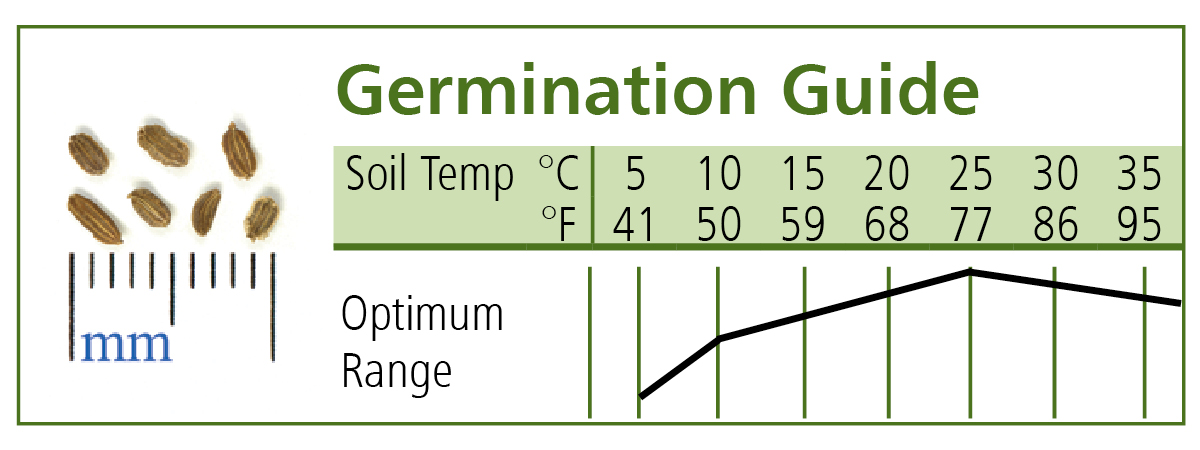
Sow from early spring to midsummer, ¾" apart , ¼– ½" deep, in 2" wide band (about 16 pellets/ft.), or single rows 16–24" apart. For minimum soil compaction, use raised beds with 2 or 3 rows 16–24" apart, beds 5–6' on center. Sprinkle the soil surface to keep moist. Don't allow soil to crust before the emergence of seedlings which takes 1–3 weeks, depending on temperature and moisture. If necessary, thin young seedlings to ¾–2" apart, depending on type or root size desired. Keep weed-free by tine weeding and shallow hoeing. To prevent greening, cover exposed crowns.DISEASES:
Blights can reduce yield and quality. Alternaria blight shows as brown-black lesions edged with yellow on leaf margins beginning on oldest leaves. Leaflets may shrivel and die. Cercospora blight first appears as small dark spots with yellow margins on the younger leaves and stems. To prevent blights, practice a 3-year crop rotation. Copper fungicides can be employed as a preventive measure or control.INSECT PESTS:
Carrot rust flies and wireworms. Provide fertile growing conditions and avoid ground recently in sod if possible. Exclude adult insects with fabric row covers.HARVEST:
Carrots may be dug any time after they reach the desired size. Generally the best harvest period lasts about 3 weeks (longer in cool, fall weather), after which time the roots may crack or the taste and appearance may decline. Make a few sowings at 3 week intervals for a continuous supply of tender carrots at their prime.STORAGE:
Plant carrots intended for winter storage about 100 days before expected fall frost. Carrots store best at 32°F (0°C) and 95% relative humidity.CARROT TYPE:
Each type is identified in the description. Nantes are medium length and cylindrical. The Shipping/Imperator types have the extra length and durability required in conventional packaged carrots, and perform the best in deeply worked soil. Chantenays are top-shaped and suitable for shallow or heavy soil. Kuroda types have thick, tapered roots and can be darker than average in color. They are suitable for tropical winter production (CA, TX, FL) or temperate summer production (where winters get below 45–50°F [7–13°C]).PELLET STORAGE:
Pelleting offers many advantages, but the pelleting process also shortens the shelf life of the seed. We recommend using pelleted seed within one year of purchase. If you need to store pelleted seeds until planting, protect them from heat and humidity in a cool, dark, dry place. If you prefer to store your seed in the refrigerator, be sure to place the seed in an air-tight container to protect it from fluctuations in humidity.AVG. SEEDING RATE:
348,480 pellets/acre at 16 pellets/foot, ¾" spacing in rows 24" apart, or 16,000 pellets/1,000 foot row.PELLET SIZE:
11.5 or 13.0.SEED SPECS:
PELLETS/LB.: 16,700–29,200 (avg. 22,600).PACKET:
250 pellets sows 15' at 16 pellets/ft.Johnny's is committed to your success, every step of the way.
We want you, our customer, to be 100% satisfied with all of our seeds, tools, and supplies.
If anything you purchase from us proves unsatisfactory, we will either replace the item or refund the purchase price.