

Brandywine Organic Tomato Seed
Quick Facts
-
Latin Name
-
Solanum lycopersicum
-
Days To Maturity
Days To Maturity
Average number of days from seeding date to harvest, within a specific crop group. If a transplanted crop: average number of days from transplant date. Not sure if crop is direct-seeded or transplanted? Check the Growing Information box for details. If crop can be both direct-seeded or transplanted, days to maturity refers to direct seeding. Days to maturity for all flowers and herbs is calculated from seeding date.
×
-
78 days
-
Life Cycle
Life Cycle
Plants can be Annuals (single growing season), Perennials (grow year after year), Tender Perennials (grow year after year in warmer climates; and in some cases when given special protection in colder climates), or Biennials (require two years to mature).
× -
Annual
-
Hybrid Status
Hybrid Status
Hybrid: The offspring of a cross between two or more distinct parent lines, usually of same species, and selected for improved traits.
×
Open-pollinated: A non-hybrid variety that can reproduce itself in kind, demonstrating relatively stable traits from one generation to the next. -
Open Pollinated
-
Product Features
Product Features
-
 Organic Seeds, Plants, and Supplies
-
Plants, or seeds harvested from plants, that have been grown without synthetic fertilizers or pesticides, strictly adhering to the USDA's National Organic Standards Board (NOSB) organic gardening practices are designated as Organic.
Supplies that meet the USDA's National Organic Program (NOP) rules according to a third-party authority such as OMRI, WSDA, and/or a local authority such as MOFGA or NOFA. -
 Heirloom
- Seeds saved over many years and passed down, in original form, from generation to generation.
-
-
Brandywine Organic Tomato Seed
One of the most flavorful tomatoes.
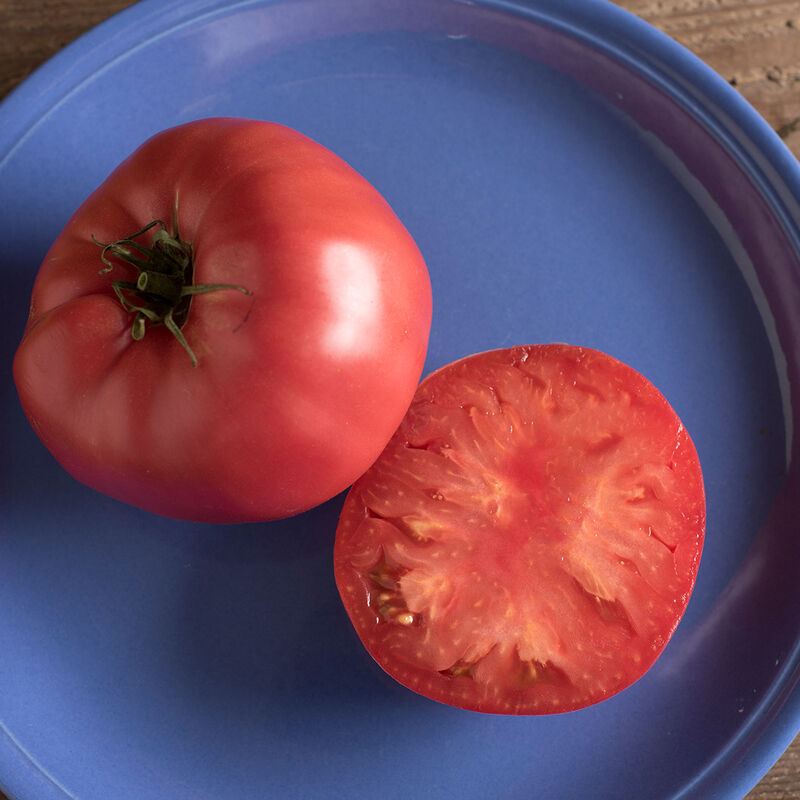
We describe Brandywine's luscious, heirloom flavor as "very rich, loud, and distinctively spicy." The large fruits, often over 1 lb., have a deep pink skin and smooth red flesh. The medium-tall, potato-leaf plant is best staked or caged. Our 'Quisenberry' strain is considered among the best. Indeterminate. USDA Certified Organic.Specs:
Quick Facts
-
Latin Name
-
Solanum lycopersicum
-
Days To Maturity
Days To Maturity
Average number of days from seeding date to harvest, within a specific crop group. If a transplanted crop: average number of days from transplant date. Not sure if crop is direct-seeded or transplanted? Check the Growing Information box for details. If crop can be both direct-seeded or transplanted, days to maturity refers to direct seeding. Days to maturity for all flowers and herbs is calculated from seeding date.
×
-
78 days
-
Life Cycle
Life Cycle
Plants can be Annuals (single growing season), Perennials (grow year after year), Tender Perennials (grow year after year in warmer climates; and in some cases when given special protection in colder climates), or Biennials (require two years to mature).
× -
Annual
-
Hybrid Status
Hybrid Status
Hybrid: The offspring of a cross between two or more distinct parent lines, usually of same species, and selected for improved traits.
×
Open-pollinated: A non-hybrid variety that can reproduce itself in kind, demonstrating relatively stable traits from one generation to the next. -
Open Pollinated
-
Product Features
Product Features
-
Organic Seeds, Plants, and Supplies
-
Plants, or seeds harvested from plants, that have been grown without synthetic fertilizers or pesticides, strictly adhering to the USDA's National Organic Standards Board (NOSB) organic gardening practices are designated as Organic.
Supplies that meet the USDA's National Organic Program (NOP) rules according to a third-party authority such as OMRI, WSDA, and/or a local authority such as MOFGA or NOFA. -
Heirloom
- Seeds saved over many years and passed down, in original form, from generation to generation.
-
-
- This product does not ship to the following countries: Austria, Australia, Belgium, Bulgaria, Cyprus, Czech Republic, Germany, Denmark, Estonia, Spain, Finland, France, United Kingdom, Greece, Croatia, Hungary, Ireland, Italy, Japan, Republic of Korea, Lithuania, Luxembourg, Latvia, Netherlands, Poland, Portugal, Romania, Sweden, Slovenia, Slovakia, Taiwan.
SCIENTIFIC NAME:
Solanum lycopersicumDAYS TO MATURITY:
From transplants.DETERMINATE (BUSH):
Varieties do not need pruning and may be grown with or without support; fruit ripens within a concentrated time period.INDETERMINATE (CLIMBING):
Varieties should be staked, trellised, or caged, and pruned for best results; fruit ripens over an extended period.CULTURE:
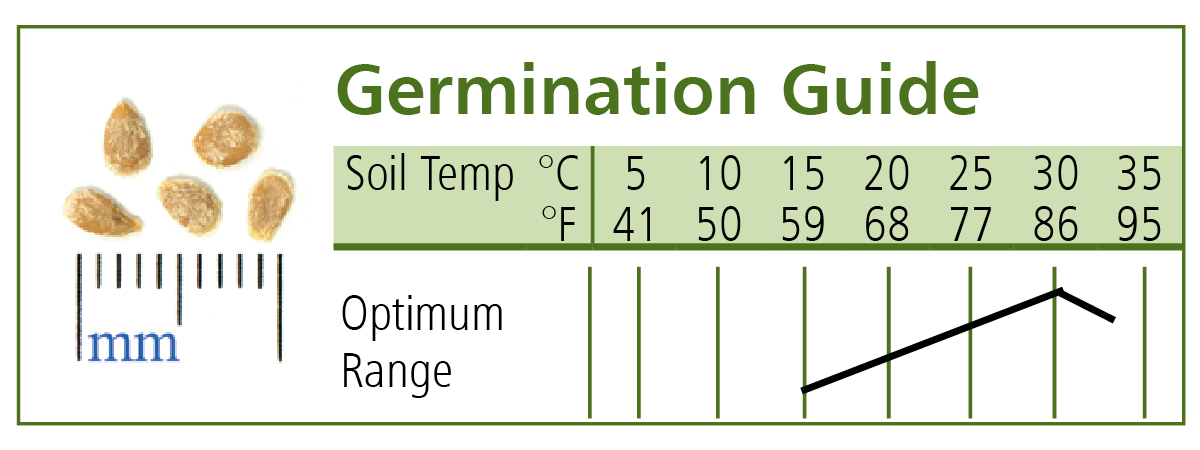
Medium-rich soil with pH 6.0–6.8 preferred. Fertilize accurately since excess nitrogen causes rampant growth, rot, and delayed ripening. For short determinates, succession-plant every 4–6 weeks. Tomatoes typically germinate in 5–7 days.TRANSPLANTING:
Don't start too early—leggy, root-bound, or flowering transplants can cause stunting and reduce early production. About 5–6 weeks before transplanting, sow 1/4" deep in 20-row flats with 20 seeds/row, or in 200-cell trays with 1 seed/cell; lightly cover. Keep mix at 75–85°F (24–29°C) with moderate moisture. At first true leaf, pot-up to 50-cell trays or 4" pots, depending on expected transplant timing. Grow at constant 60–70°F (16–21°C) temp and use complete fertilizer until hardened off. Supplemental lights and lower night temps control stretching. For earliest crop, plant under row cover around last frost date. Avoid exposing unprotected plants to consecutive nightly temperatures below 45°F (7°C). In rows 4–6' apart, space determinates 12–24" and indeterminates 24–36". Plant deeply to encourage adventitious rooting. Water seedlings with a high-phosphate fertilizer solution at planting to help boost early yields.TRELLISING: Basket-weave by pounding 5–6' stakes every 2–3 plants, using heavier t-posts intermittently and at ends of beds. For tall indeterminates, consider short extensions or pruning once they outgrow a manageable size for easy harvest.PRUNING: Indeterminates likely benefit by removing all suckers under the first strong branch directly below the first flower cluster. The lower bottom suckers often miss trellis supports, set fruit closer to soil, take energy from upper parts, and encourage spread of disease from soil. If needed later in season, consider thinning out leaves to increase airflow or topping plants to help finish ripening last fruits.INSECT PESTS AND DISEASE:
Learn your common pests and options for control, including resistant cultivars and pesticides. Avoid wet leaves and handling when wet or using tobacco products. Manage plant debris and crop rotations.HARVEST:
Fruits ripen gradually from the blossom end to shoulders and from the base of clusters to the tips. Harvest softer fruit unstacked into shallow, padded trays. Use fully ripe fruit only for local retail or home-use. To deliver sound fruit, pick less ripe the further the distance and the longer the time between field and customer. Any fruit breaking color will still ripen post-harvest. Calyx can be removed or kept to prove freshness.STORAGE:
Store blemish-free, near-ripe fruit 4–7 days at room temperature in darkness. Store longer with proper variety selection, picking less-ripe, and keeping at cooler temperatures 45–60°F (7–16°C). Colder and picking too green will sacrifice end-quality.TRANSPLANTS:
Avg. 850 plants/1,000 seeds, 10,200 plants/oz.SEEDS/OZ. (AVG.):
11,000–13,000.PACKET:
40 seeds, unless otherwise noted; plants about 60 feet.Johnny's is committed to your success, every step of the way.
We want you, our customer, to be 100% satisfied with all of our seeds, tools, and supplies.
If anything you purchase from us proves unsatisfactory, we will either replace the item or refund the purchase price.