

Who owns Johnny's Selected Seeds?
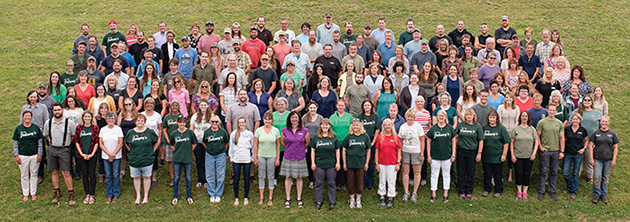
Johnny’s Selected Seeds was a sole proprietorship from January 1973 until July 1975, when the company was incorporated in Maine. Over the years, Johnny’s has grown on the good graces of its customers and the company never received investments from any source. This changed in July 2006, when Johnny’s Selected Seeds took investment from its employees. Johnny’s Selected Seeds employees own 30% of the company with 100% ownership expected in 2015.
Johnny’s Selected Seeds has no affiliation with Monsanto Company.
A concerned customer wrote a letter to Johnny’s and asked for a personal response from Rob Johnston, founder and chairman of Johnny's. The customer’s letter and Rob’s response addresses the question of “Who owns Johnny’s” and Johnny’s sourcing of seeds with Seminis, a division of Monsanto. Both Rob and the author of the letter have consented to the posting of this exchange to help dispel the erroneous rumor that Monsanto owns Johnny’s.
Customer letter that was emailed to Rob:
Date: Thu, 26 Feb 2009 11:29:55 -0500
To: <publicrelations@johnnyseeds.com>
Subject: Monsanto seeds
Hello
This is addressed exclusively to Rob Johnston Jr. please.
I have ordered seeds from your company every year since perhaps 1982,
if not in my own name, under my previous married name. Two years ago, I
read Barbara Kingsolver's book, ANIMAL, VEGETABLE, MIRACLE. I was
greatly dismayed to read on page 52 the following, "Agribusiness can
patent plant varieties for the purpose of removing them from production
(Seminis dropped 25 % of its total product line in one recent year, as
a "cost-cutting measure"), leaving farmers with fewer options each
year. This is true for home gardeners, who rarely suspect when placing
orders from Johnny's, Territorial, Nichols, Stokes, and dozens of other
catalogs that they're likely buying from Monsanto."
I am very opposed to genetic modification of seeds , particularly when
they have a destroyer gene that does not allow poor farmers to save
seeds from their crops for planting the following year. I also am
deeply opposed to Round-up and all chemicals, and to Monsanto's
monopoly of seed production and distribution. I believe that
biodiversity and organic growing methods are crucial to our environment
and the people of the world. If appropriate practices are used to
promote soil health, genetic modification is not necessary. At this
critical time in the history of our planet, I feel we have to
re-examine our priorities, especially when it comes to the growing and
TRANSPORTING of food.
Please talk to me about this. I did not order from you last year
because of this, and I want to hear your thoughts. Your mission begs
the question of why you would trade with Monsanto, and why all your
seeds aren't organic.
Your courteous reply to my query will say alot about your conviction to
"helping families, friends and communities feed one another"
Rob’s response to the customer:
I'm glad that you finally wrote to me. Thank you.
I know about Barbara Kingsolver's book, but haven't read it, and
hadn't seen the passage that you quoted.
.
Monsanto is primarily involved in the big acreage agricultural
crops like corn, soybeans, cotton, and canola; they are less involved in
horticultural crops, i.e. vegetables, flowers, and herbs. Monsanto's
bread and butter is selling genetically engineered "traits" to plant
breeders on a royalty basis, for example a trait conferring herbicide
resistance.
The plant breeder then utilizes ordinary plant breeding
(manipulation of mating) to transfer the engineered trait to his/her
parent lines. The breeder (breeder's company) sells the finished
varieties and pays Monsanto a royalty. The only horticultural seeds
that I know of that contain engineered traits are sweet corn (Monsanto
and Syngenta developed traits) and summer squash.
Johnny's has never sold a variety with engineered traits.
For about four years Monsanto has been directly involved in
vegetable seeds, since buying Seminis Vegetable Seeds, a California
company.
Seminis is a consolidation of a number of formerly independent
seed companies, including Royal Sluis (Netherlands), Petoseed (US),
Asgrow (US), and Hungnong (Korea). It was a Mexican owner/conglomerator.
Seminis is international, with its head office in Oxnard, California. In
2003 the Mexican owners (along with the public that owned a portion of
the stock) sold to Fox Paine, a US investment group. In early 2005 Fox
Paine sold Seminis to Monsanto.
Consolidations are usually not beneficial to the customer, and
these are no exception. With the original Seminis consolidation came a
reduction of service and a focus on big acreage markets, not the needs
of Johnny's core customers which are the specialty and small commercial
growers and avid home gardeners.
So for probably 15 years now we have been active in finding
alternatives to Seminis varieties, with a preference for products from
independents. Presently Johnny's carries about 40 Seminis varieties,
which is about 4% of our vegetable varieties. Our intention is to
continue replacing them.
The Monsanto acquisition isn't surprising. It's unfortunate, but
it isn't a huge deal for Johnny's and our customers in terms of variety
selection. And practically Johnny's doesn't have to make a shift, since
we were already working to minimize their presence.
A lot of people got from the Kingsolver book that Monsanto owns
Johnny's. Neither Monsanto nor any of their affiliates owns any of
Johnny's. Johnny's is owned by my wife, Janika, and I and most of the
other employees of Johnny's. To date the employees, via an Employee
Stock Ownership Trust, have acquired 30.44% of the stock. The plan is
for them to have acquired and paid for 100% by 2015.
I agree with your preference for an organically grown and more
local food supply. The big seed companies are focused on the big
acreage productions, both for processing and fresh market. They have
less, sometimes no, interest in small acreage growers. There is an
increase these days that you, no doubt, have noticed of small farmers
growing produce for local and regional markets, and the "local foods"
trend that is fueling that increase. Seeds from the big companies are
in declining usage by these small growers. The big seed companies'
varieties are oriented largely to mass markets and shipping. A portion
of those varieties will work for the small growers, but the local niches
want quality traits not always available. That's where Johnny's comes
in -- these smaller commercial growers and avid home gardeners are our
bread and butter.
I don't see plant genetic resources being locked up by the
conglomerates, because the germplasm collections are public.
My main concern about Monsanto is the consolidation. I have
watched consolidating in the seed industry since 1973 when I started
Johnny's. With each consolidation something is lost for the customer,
the farmer or gardener, and, by extension, the consumer. Monsanto has a
considerable consolidation now in vegetable seeds.
You might be interested in www.seedquest.com . At the Seed
Quest website you can follow press releases and seed industry news --
the lion's share of it is from the big companies. But it will give you
the flavor of the seed world out there, and how the individual small
farmers and gardeners need a trustworthy place to go that can
competently screen through all of it.
Organically grown seeds. The percentage of our seeds that are
organically grown is increasing. It's our intention to continue working
on that. Since the beginning of Johnny's I've been most enthusiastic
about the product development, i.e. giving our customers improved
varieties to support their farm and home economies and quality of life.
While I've always been interested in the seed production, as I'd have to
be to grow a seed company, the production has been behind the product
development in my priorities. In addition to our own plant breeding
work here, we screen hundreds of varieties each year from dozens of
cooperators. That's how we make decisions about product line changes.
Typically a new variety will be proprietary with the originator, and we
have nothing to say about how their seed production is farmed.
So while we prefer organically grown seeds, the majority of the
varieties that we carry are not OG. As you might know, certified
organic farmers are allowed to use non-OG seeds "if equivalent OG seeds
are not available." In practice that means that if a variety that an
organic farmer wants to use is not available OG, s/he may use the non-OG
seeds as long as those seeds are not treated with chemical fungicides or
other non-approved seed treatments.
There are a number of companies that carry only OG seeds. Do
you know about High Mowing Seeds in Wolcott, Vermont?
http://www.highmowingseeds.com They are one of the best of the only-OG
seed companies focusing on vegetable seeds. Their product line is
limited compared to Johnny's because of the unavailability of many
important varieties grown organically, but they are doing well within
that constraint.
With conventional agriculture becoming more environmentally
friendly and organic agriculture becoming more technically
sophisticated, my vision is that the two will become merged. But that's
getting a bit off-topic.
Have I answered your questions? Please write if you would like
clarification, elaboration, if I have missed something, or if you have
additional questions. You are also welcome to call me at
1 (877) 564-6697, extension 427.
I hope you don't mind that I am going to send a copy of this to
a few people at Johnny's who will be interested.
Sincerely,
Rob Johnston
Comments and concerns about this topic may either be addressed to publicrelations@johnnyseeds.com or please feel free to talk to Rob Johnston as he has invited.

Connect with Johnny's