

Tips for Starting a U-Pick Highbush Blueberry Operation
Highbush blueberries are a popular option for a U-pick crop. They are among the easiest U Pick crops for customers: they don’t require bending over, the fruit is clearly visible rather than hidden behind foliage, and it’s obvious when the berries are ripe. Plus, the berries tend to hold well on the plant and in storage. With proper maintenance, established bushes produce high yields of berries over a long period of time. And of course, the flavor of the fruit is far superior to anything you can buy in the supermarket.
About Our Interviewees
To learn more about establishing a U-Pick blueberry patch and to gather recommendations for growers starting out with U-pick, Johnny’s talked with two U-pick highbush blueberry farms:
- Harrietta’s Blueberry Hill, Larry Waldo & Rosemary Rokita, Harrietta, MI, USDA Zone 4a.
Established in 1989, Harrietta’s Blueberry Hill is located on 40 acres in northern Michigan and owned by Larry Waldo and Rosemary Rokita. The farm began with both U-pick and wholesale highbush blueberries and then transitioned to become exclusively U-pick. The farm has 4 acres of bushes producing approximately 3,000to 12,000 pounds of berries each year (all weather dependent). -
The Earley Farm & Nursery, Matt & Kristen Earley, Wales, ME, USDA Zone 5b.
In 2020, Kristen and Matt Earley purchased their farm in central Maine. The Earley Farm & Nursery offers U-pick highbush blueberries, strawberries, and raspberries, a self-serve farmstand, wholesale fruit, nursery plants, and bulk materials. The farm has 1 acre of mature highbush blueberries grown using organic practices.
Variety Selection
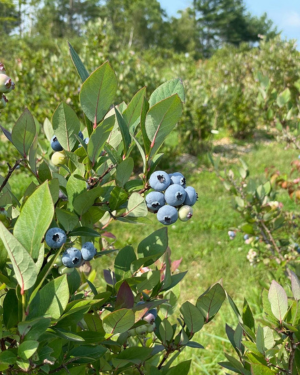
Both Harrietta’s Blueberry Hill and The Earley Farm & Nursery rely on the tried-and-true performance of old standard varieties like ‘Patriot’ and ‘Bluecrop’.
Both Harrietta’s Blueberry Hill and The Earley Farm & Nursery rely on the tried-and-true performance of old standard varieties. At Harrietta’s, they have approximately 12 varieties of berries. Most are ones developed by universities in Michigan, Minnesota, New York, and New Jersey. They have found that in their region of northern Michigan, the older varieties (like ‘Bluecrop’, ‘Blueray’, ‘Patriot’, and ‘Herbert’) have been the most consistent, proving themselves to work well in their soil and climate. Similarly, The Earley Farm & Nursery relies on ‘Patriot’ and ‘Bluecrop’ for an abundant and reliable crop.
To choose varieties, Larry did a lot of reading from Michigan State University, University of New Hampshire, and University of Minnesota bulletins (this was back in the 1980’s; long before the internet!) and spoke and wrote to university researchers, and commercial blueberry growers. DeGrandchamp Farms in southwest Michigan provided valuable information and is the source of most of the berries that are on the farm, even now—40 years later. “They were just as curious as the Waldos as to which varieties would grow in northern Michigan, known to have minus 40 degree temperatures,” said Larry.
Season Extension Through Variety Selection
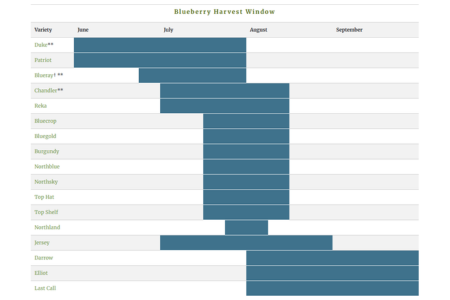
“The patch should have a mix of early season, mid-season, and late season ripening-berries for your area,” recommends Larry. “This will allow the patch to provide ready-to-pick berries for 6–8 weeks. You want to avoid having your crop producing all at once (unless you prefer to be open for only 2 weeks a year!)” The U-Pick season at Harrietta’s Blueberry Hill generally begins in mid-July and lasts through Labor Day; about 6 weeks.
With their plantings of ‘Patriot’ and ‘Bluecrop’, The Early Farm & Nursery achieves a similar U-Pick window, typically opening for U-Pick in mid-July and lasting through early September, depending upon weather and pest pressure. “It’s a pretty long season with the varieties we have” Kristen explains.
- For more information on variety selection for season extension, visit the Johnny’s Blueberry Harvest Program.
Field Layout & Parking
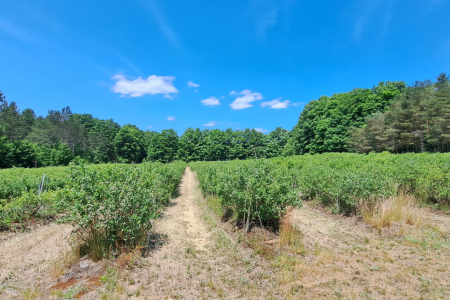
At Harrieta’s Blueberry Hill, there are 30 rows planted with about 175 bushes each. Rows are planted 8-feet apart from the center of the beds to accommodate a compact tractor and to provide ample room for pickers.
Both farms have a farm road that brings pickers to a parking lot and staging area adjacent to the berry patch. At Harrietta's Blueberry Hill, there are 30 rows planted with about 175 bushes each, approximately 5,300 bushes. Rows are planted 8-feet apart from the center of the beds to accommodate a compact tractor as well as to provide ample room for pickers. At The Earley Farm & Nursery, there are 15 rows of bushes, each numbered and labeled for easy communication to pickers as to which rows are the best picking on any particular day.
Staging Area
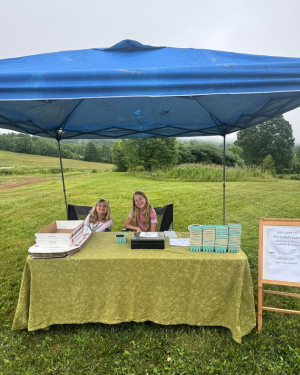
Staging area at The Earley Farm & Nursery.
A simple staging area at The Earley Farm & Nursery consists of a tent and table, and signage with the price and what they are picking. At Harrieta’s Blueberry Hill, where the berries are priced by the pound, the staging area includes a scale and gallon pails that customers can pick into. They also provide a porta-potty, and a water hose and bar soap for handwashing. Typically, Larry is able to direct and show people where to pick and someone else is at the entrance/exit to welcome customers and help with check out.
Picking Instructions
Kristen emphasizes the importance of giving full instructions to first-time U-pickers. Not everyone has picked berries before, so she recommends a polite introduction and overview of the process—a quick intro can include things like who provides the containers, when to pay and what the price is, how to tell which berries are ripe, and which rows might have the best picking.
She also encourages pickers to try the berries to see how the flavor differs between varieties. “These are not your supermarket berries; they taste really good” she says. “Some people haven’t had really great blueberries before. Once customers taste them, they realize the value of what they are picking.”
Blueberry Hill also encourages pickers to sample berries as they are picking. Their motto is “If you like them when you pick them, you’ll like them when you get home.”
Payment Methods
Harrietta’s Blueberry Hill accepts cash and local checks. “For the most part this has not caused a problem,” says Larry. “Sometimes, people have had to mail us checks as they didn’t bring enough money, or their wallet, or didn’t know about the cash/check only policy. So far, so good.”
The Earley Farm & Nursery also accepts cash and checks as well as Venmo. They have Square for point-of-sale credit card transactions, but they limit its use to larger purchases because of the transaction fee.
People Management
Signage
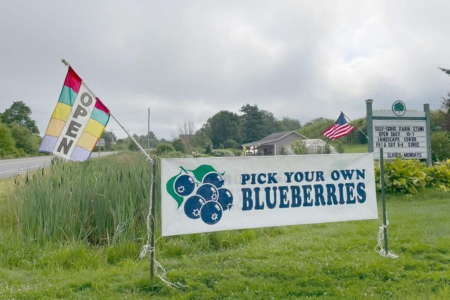
Plenty of clear signage is helpful for directing traffic.
An open flag at the road (and even at nearby intersections) can be helpful in increasing awareness of your farm and for drawing in passers-by. “Having a lot of signage is super helpful,” says Kristen. The Earley Farm has both an open flag at the road and another sign halfway up the driveway that clearly states their status (open/closed) and hours of operation. She recommends signage for open hours, arrows to direct traffic, signage and parking cones for parking, etc. “It really has to be in people’s faces to see it” she notes.
Children & Pets
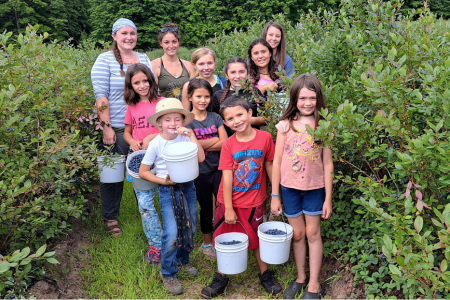
Harrietta's Blueberry Hill is already seeing 3rd generation children picking their own berries.
Both farms welcome children and neither have had any major issues them on the farm. Says Larry “We are already seeing 3rd generation children picking their own berries!”
Safety & Liability
Both farms carry liability insurance, of course, but neither report any major safety issues beyond the occasional hornet nest or poison ivy patch. Kristen recommends prominent signage alerting drivers to any necessary cautions like children and pets that live on the property.
Open Hours
Harrietta’s Blueberry Hill was initially open for U-pick 7 days per week, but eventually they found that Thursdays, Fridays, and Saturdays were the busiest days and they decided to concentrate on those days. This also gave them a window of time to treat pest and fungus issues when they arise (pesticide spraying requires a 3–4-day window with no picking.) The Earley Farm & Nursery is open on Fridays, Saturdays, and Sundays for U-pick. However, customers can purchase pre-picked berries at their self-serve farm stand 7 days per week.
Marketing & Communications
Location & Online Visibility
Both farms are located in popular areas for vacationers, which is very helpful in drawing pickers. Harrietta’s Blueberry Hill is near Lake Michigan and Huron Manistee National Forest, while The Earley Farm & Nursery is in the lakes region of central Maine, both of which are popular summer vacation destinations for outdoor enthusiasts. “People who like to be outdoors are people who are more likely to want to pick blueberries. More than a few people have come with their kayaks or bikes on their vehicles as they come to pick berries in the midst of other activities,” reports Larry. “Google has been our best friend in finding us” he adds; tourists find the farm readily through internet searches.
Marketing Channels
Both farms have a Facebook page that serves as a mechanism for announcing open hours or special events. Harrietta’s Blueberry Hill also advertises in local newspapers. The Earley Farm & Nursery has a relationship with several local farmstands who buy their berries wholesale; when farmstand customers ask for U-pick options, they send them to The Earley Farm. Word of mouth for both farms is strong.