

- Basil Downy Mildew and Prospera® DMR Basil | Breakthrough Breeding Innovation Provides Solutions
- Prospera® DMR Basil Comparison Chart | Johnny's Selected Seeds
- Prospera® Red Downy Mildew-Resistant Basil
- Prospera® Downy Mildew-Resistant Basil
- Basil | Key Growing Information
- Basil Varieties | Comparison Chart (PDF)
- Hydroponic & Container Basil Guide | Production Advice & Variety Recommendations
- Ornamental Basil | Key Growing Information
- 'Everleaf' Basil | The extremely slow-to-bolt, compact Genovese basil
- Beyond Blossoms | Expanding & Diversifying Your Dried Floral Menu
- Johnny's Edible Flower Guide | Printable 4-pp Brochure (PDF)
- Basil Downy Mildew Awareness & Prevention
- Mia Prospera® Active DMR – Organic Basil Variety from Johnny's
- Lihi Prospera® Active DMR – Organic Basil Variety from Johnny's
- Common Pests & Diseases of Basil
- How and When to Prune (Pinch) Basil
- Noga Prospera® Active DMR – Organic Basil Variety from Johnny's
- Webinar Slide Deck | New-for-2023 Vegetables & Herbs | PDF
- High-Value Crops & Varieties for Your Garden • Tutorial with Niki Jabbour
- Disease-Resistant Basils from Johnny's • Tutorial with Niki Jabbour
Basil Downy Mildew Awareness & Prevention
Basil downy mildew is a disease caused by the fungus-like pathogen Peronospora belbahrii. While many other pathogens go by the common name of downy mildew, P. belbahrii is host-specific to basils, meaning that it is found exclusively on basil. Although first reported in the early 1930s in Africa, basil downy mildew emerged elsewhere only many decades later, to become the most significant global pathogen of basil today, causing serious damage to field, tunnel, and greenhouse basil productions worldwide. Basic knowledge about its lifecycle, maintaining vigilance for occurrence in your area, using resistant varieties when appropriate, and being able to quickly recognize symptoms and report outbreaks are all key to effective prevention and control.
Description
Basil downy mildew is most common on sweet basils (Ocimum basilicum), the most economically important group, but can afflict the more than five dozen basil species and subspecies. The pathogen can be spread by contaminated seed, infected basil leaves or plants, and as wind-dispersed spores, which can travel long distances. As of this writing, there are no commercially standardized tests available to determine the contamination of individual seed lots.
Once the pathogen is introduced, an abundance of spores develop on the undersides of the infected plant’s leaves, given favorable conditions, and it can quickly become airborne and spread widely. It can persist in locations where basil is produced yearround, at warmer latitudes and in greenhouses and tunnels under winter production. P. belbahrii requires a living host to survive, however; its spores are not soilborne, and the pathogen does not overwinter at higher latitudes where basil is not grown continuously.
Conditions favorable to disease development include high humidity levels, extended periods of leaf wetness, mild temperatures (68°F/20°C), and at least 7½ hours of darkness.
Symptoms of Downy Mildew
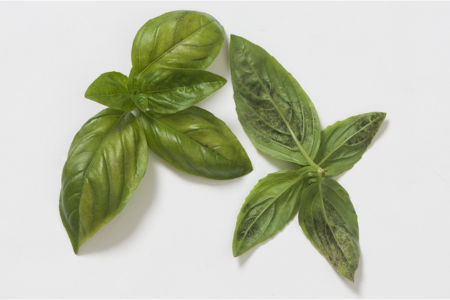
Basil leaves infected with basil downy mildew.
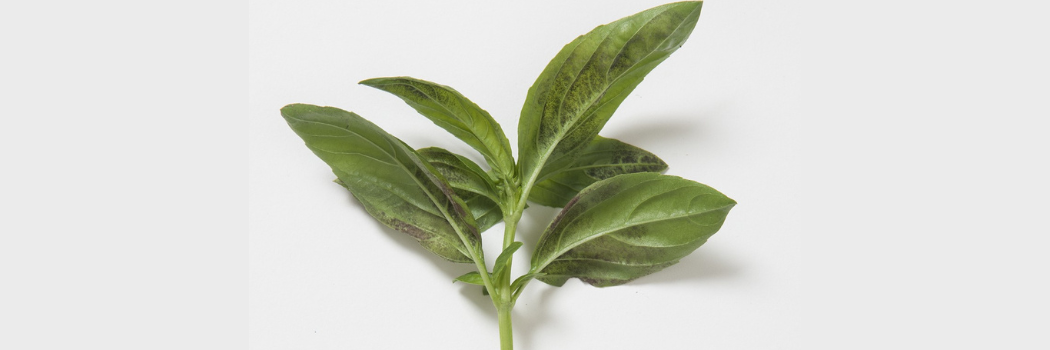
Basil downy mildew is characterized by slight yellowing on the upper side of the leaves, often in bands between leaf veins, resembling a nutritional deficiency or sunscald. Purplish-gray spores develop on the lower surface, producing black “fuzz” on the underside of the leaf. More mature, dense, lower leaves are often first to become infected with the disease, which then quickly spreads up the plant and infects newer growth.
Monitoring
Because the pathogen is readily spread by wind-dispersed spores, monitoring programs are crucial to early detection and treatment. Inspect and monitor plantings on a regular schedule.
Tips for Monitoring
- Check the lower leaves first, since the disease usually affects this area of the plant first.
- Purplish-gray spores on the undersides of the leaves are a clear indicator of infection.
- Stay up-to-date on reports of disease development in your region, especially during periods when conditions for disease development are optimal.
In 2009, Cornell University began a monitoring program for growers to contribute their observations. An updated monitoring platform, to review and report incidence, is available at: https://basil.agpestmonitor.org
Downy Mildew Prevention
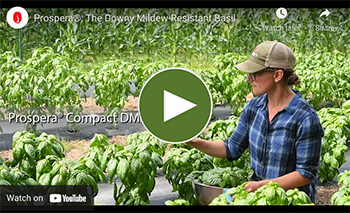
Johnny's basil trial technician Rachel Katz and product manager Hillary Alger present a synopsis of their extensive trialing research on downy-mildew resistant Prospera® basil varieties.
To reduce the risk of disease development:
- Select resistant varieties to grow.
- Keep foliage dry.
- Use drip irrigation or bottom-watering wherever possible to minimize humidity and leaf wetness.
- Position plantings to ensure good airflow within and between rows, seedling flats, or containers.
- A regular schedule of fungicide applications can provide a degree of protection against infestation, but only when used prior to the development of the disease in an area. Some effectiveness has been shown with preventative applications of Actinovate® and OxiDate®, both of which are OMRI-approved materials.
- Harvest early if the disease is present or the risk of infection is high due to disease presence in the area.
- Remove and destroy any infected plants.
- Report outbreaks to your local Cooperative Extension Service and your neighbors, as well as the Cornell site.
Downy Mildew Resistant Varieties
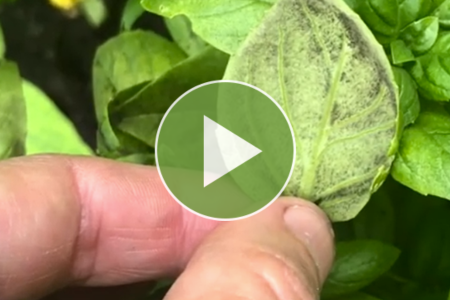
Learn about growing basil downy mildew resistant varieties in the home garden.
After many years of careful selection, there are now several basil varieties that offer a stronger level of resistance than the first generation of resistant varieties, though they are still not immune. Furthermore, reports suggest that there may be multiple strains (or races) of mildew that correspond to different geographical locations. However, since no race-specific information is currently available, we recommend you trial these varieties to see which one(s) best suit your needs.
References & Further Resources
- Extension articles and meeting presentations about basil downy mildew (Cornell University)
- To report incidence, visit https://basil.agpestmonitor.org
- Wyenandt, C.A., et al. 2015. Basil downy mildew (Peronospora belbahrii): Discoveries and challenges relative to its control. Dis. Control & Pest Mgt., (105) 7. URL (PDF): https://apsjournals.apsnet.org/doi/pdfplus/10.1094/PHYTO-02-15-0032-FI (accessed 04.10.2026).