

- Alfalfa & True Clover Inoculant | Label
- How to Make Compost for Your Garden • Tutorial with Niki Jabbour
- Exceed Alfalfa/True Clover Inoculant | Information Sheet (PDF)
- Exceed Alfalfa/True Clover Inoculant | OMRI Certificate
- Exceed Garden Combination Inoculant | Information Sheet (PDF)
- Exceed Garden Combination Inoculant | OMRI Certificate
- Exceed Pea, Vetch & Lentil Inoculant | Information Sheet (PDF)
- Exceed Pea, Vetch & Lentil Inoculant | OMRI Certificate
- Exceed Peat Rhizobium Inoculants | SDS (PDF)
- Exceed Soybean Inoculant | Information Sheet (PDF)
- Exceed Soybean Inoculant | OMRI Certificate
- Inoculants | General Information Sheet
- Organilock | OMRI Certificate
- Soybean Inoculant | Label
- Trap Wire Compost Bin & Add-on Bin Assembly | Tech Sheet (PDF)
- How to Make Compost: Methods for Farm & Garden
- Cover Cropping for Field & Garden | Johnny's Educational Webinar Resources
- OK to Compost Certificate | 22mm Compostable Trellis Clips
- Webinar Slide Deck | Soil Health and Management Strategies | PDF
- Soil Health and Management Strategies | Webinar Recording
- Soil Health and Management Strategies | Johnny's Webinar Series
- The Amazing World Beneath Our Feet: An Introduction to Soil Health
- Implementing No-Till Farming Practices
- Cover Crops Information Library | Johnny's Selected Seeds
- Exceed Peanut Cowpea Lespedeza Mung Bean Inoculant | Label
- Exceed Peanut Cowpea Lespedeza Mung Bean Inoculant | OMRI Certificate
How to Make Compost: Methods for Farm & Garden
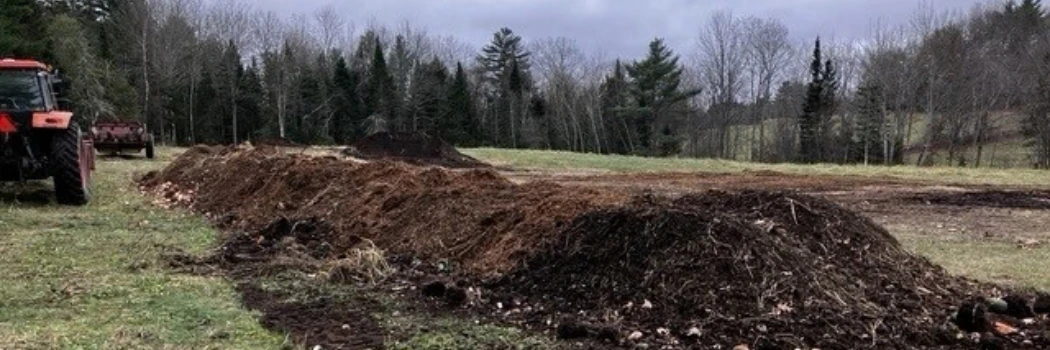
Above: Windrow compost system at the Johnny's Research Farm.
By Collin Thompson, Associate Director of Farm Operations, and Jill Porchetta, Farm Technician III, Johnny's Selected Seeds
Compost is often called "black gold" by gardeners because it transforms waste materials into one of the most valuable soil amendments available. Whether you're managing a backyard garden or a small farm, composting can improve soil health, recycle nutrients, and reduce waste while producing a free source of organic matter for your crops.
How Composting Works
The term “composting” can mean different things to different people, ranging from letting a pile of manure sit for a few years to high tech systems that monitor temperature, moisture content, and the composition of the materials added to the compost). When most people think of composting, they are generally thinking of thermophilic composting, which relies on organisms that decompose organic matter at high temperatures. This tends to be an aerobic process (requiring oxygen), which results in a clean, high-quality compost that will enhance your soil when added.
The heating process that takes place during composting has multiple benefits, most notably the destruction of weed seeds and harmful pathogens that may be present in organic matter. This ensures that compost does not present risks to plant or human health, while also preventing the importation of nuisance weeds.
Benefits of Composting
- Adds organic matter to the soil. Organic matter feeds soil microorganisms, improves nutrient cycling, and increases the soil's ability to retain moisture.
- Improves soil structure. Compost promotes the formation of soil aggregates, improving drainage, root penetration, aeration, and resistance to erosion.
- Returns minerals and nutrients to the soil. Compost helps to replenish nutrients to the soil as the feedstocks (materials added to the compost) are broken down and nutrients become available.
- Reduces greenhouse gas emissions. Food waste sent to the landfill breaks down anaerobically, resulting in emissions of methane, a greenhouse gas 28 times more powerful than carbon dioxide.1 However, when we compost food and garden waste, it breaks down aerobically, nearly eliminating methane emissions.2
- Supports Soil Biology. As described above, composting occurs through the work of thermophilic bacteria, further supported by fungi, and invertebrates like springtails and worms. Compost contains a diverse community of bacteria, fungi, and other organisms that help support biological activity in the soil and contribute to nutrient cycling.
Methods of Composting
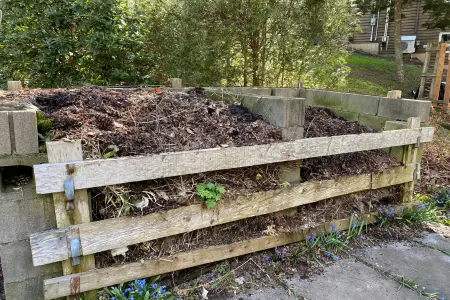
Open bins are a simple method of composting.
There are many ways to compost. The method you choose will depend on your goals and the space and equipment you have available to you. Below are the most common composting methods:
- Open Pile/Passive
- In-Vessel Systems (bins and tumblers)
- Turned Pile/Windrow Systems
- Static Aerated System
Open Pile/Passive
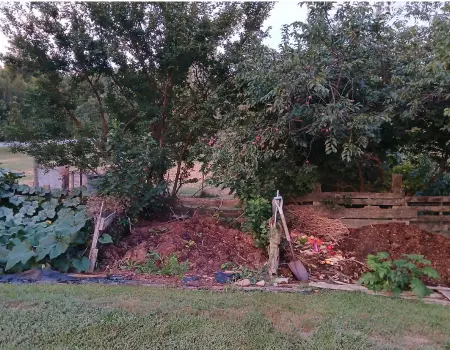
It is a good idea to have at least two bins—one for composting now, the other to hold the finished product.
Arguably the simplest method of composting is when organic matter is stacked in a pile and left to decompose until the material is uniform and fully broken down. Piles must be small enough (3–4’ tall) to allow passive airflow to the core of the pile and to dissipate excess heat, so it is best suited for gardens or small farms that do not produce/handle much material.
In-Vessel Systems (Bins and Tumblers)
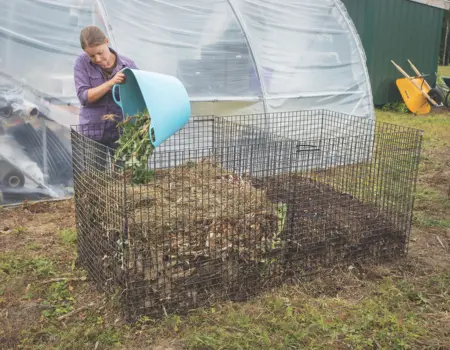
In-vessel systems can be as simple as a set of bins among which material is rotated or as complex as automatically monitored and aerated vessel composters. For most gardeners or small farms, a bin system can be a simple, low-cost option for composting. There are many types of bins available for composting, some of which require turning, while others aerate the material for you.
- Ready-made, enclosed composter or tumbler. These are space-saving options designed for home use, some of which eliminate the need for turning the pile.
- Open bins. You can build a bin system using wire, pallets, or other materials. It is a good idea to have at least two bins—one for composting now, the other to hold the finished product. More bins can be added to increase capacity and provide a continual supply of ready-to-use compost. Ideally, each bin should be between three cubic feet and five cubic feet. If it's too small, it won't heat sufficiently to decompose the materials quickly. If it's too large, it's hard to turn and care for. Be sure your bin has openings to allow for aeration as bacteria need oxygen to do their job. Place the bin in a spot where it's convenient to add materials.
Turned Pile/Windrow
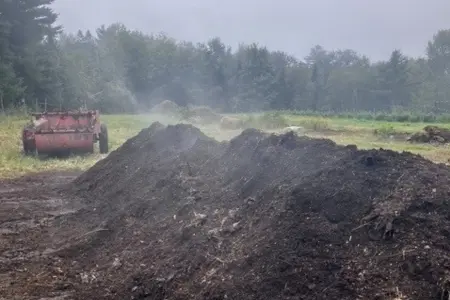
Steam is visible from this recently turned windrow at the Johnny's Research Farm.
- Turned pile/windrow composting systems are the most commonly used system in commercial composting facilities and are also well-suited to small or large farms, such as the Johnny’s Research Farm. In these systems, windrows (long piles) are built that are approximately 4–8’ tall and 8–10’ wide. They can be as long as required to match the site and amount of material being composted.
- Windrows are preferred over tall piles because there is more surface area, which helps the aerobic process take place, but piles can be used if they are moderately sized (8’x8’ or smaller).
- These piles or windrows are turned as the material heats up, mixing the material evenly and injecting oxygen into the pile.
- Look for a location that is level and well drained, with easy access for turning, especially if larger equipment is required to do so. Having space for multiple windrows is ideal so you can have space for material that is actively heating, as well as space for curing and mature compost.
Static Aerated Systems
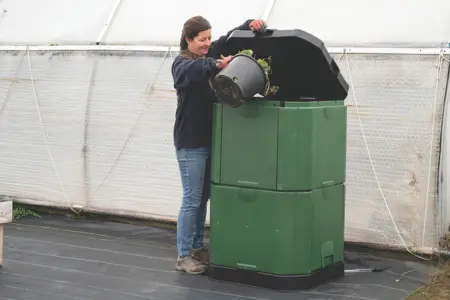
The Aerobin 400 Composter is a small-scale static aerated system, relying on a patented aeration core system to promote efficient degradation of organic matter without turning.
Static aerated systems do not get turned, and instead rely on pipes to push air through the pile, maintaining an aerobic decomposition process. Simple designs can be built out of mesh bins with perforated PVC pipes in the middle, whereas more sophisticated systems use concrete bunkers with piping running through the material.
What to add to your Compost Pile or Bin

Video: Author and four-season gardener, Niki Jabbour, reviews compost care essentials for the home gardener.
There are three essential elements to successful composting.
- Brown materials: High carbon materials, often called brown materials, include fallen leaves, straw, and shredded newspapers. They're dry and often brown in color.
- Green Materials: The nitrogen suppliers, on the other hand, are added to the bin in a fresh state, which is why they're often called the green materials. They contain a lot of moisture and are quick to decompose. Common green materials include food scraps, grass trimmings, crop residue, seaweed, coffee grounds, and manure.
- Water: Water is vital in supporting the functions of the soil biota that are working hard to turn your waste into beautiful compost. You can water your compost pile with a hose or watering can if it’s looking dry. Avoid saturating the pile, as excess moisture can create anaerobic conditions that slow decomposition and produce odors.
Because both brown and green materials contain carbon and nitrogen, the overall C:N ratio depends on the proportions and composition of each feedstock. An ideal compost pile has a C:N ratio of about 30:1. A starting mix of roughly two parts brown materials to one part green materials often produces good results, though the ideal ratio depends on the materials being used.
Materials to Avoid: Animal products (meat, fat, bones, etc), coniferous wood chips/needles, and diseased plant material should be composted with caution. While anything that was once alive can be composted, these materials can be more challenging to break down and require extra care to ensure it is done effectively and safely.
How to Care for Your Compost Pile or Bin
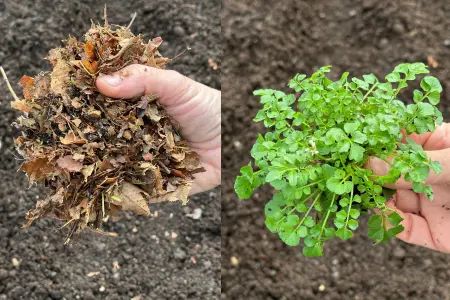
Include both brown materials (left) and green materials (right) for optimal composting.
Building the Pile (for open pile or in-vessel)
- Coarse material is often laid at the base of piles or in bins to promote airflow.
- Alternate layers of brown and green materials, watering with a hose at each layer to ensure material is sufficiently moist.
- Occasionally add a shovel full of garden soil or mature compost to inoculate the pile with beneficial microbes.
Turning
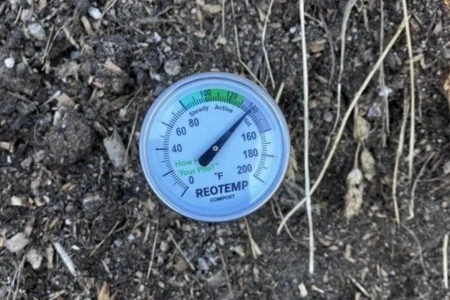
A long-probe Compost Thermometer is helpful for monitoring temperatures in piles and windrows. Turn the pile once the interior temperature is 131–170°F (55°–77°C).
- Turning reintroduces oxygen, redistributes moisture, and exposes all materials to the high temperatures needed for uniform decomposition.
- Turn your pile as it heats, ensuring material is thoroughly mixed so it heats evenly through the composting process.
- In bins, this can be done with a pitch fork or digging fork, while larger windrows are often turned with a loader tractor.
- A compost thermometer can help monitor the pile’s temperature so you know when to turn: turn the pile once the interior temperature is 131–170°F (55°–77°C)
- A low temperature can mean the C:N ratio or moisture level is off, or that the pile has gone through its heating cycle and is starting to mature.
Moisture
- The compost pile should be like a damp sponge, neither too wet nor too dry. If it seems dry, give it a watering.
- Excess moisture can reduce oxygen in the pile and inhibit aerobic decomposition. If you struggle with excess moisture, you may want to have a roof or tarp over your compost bins or pile.
Curing
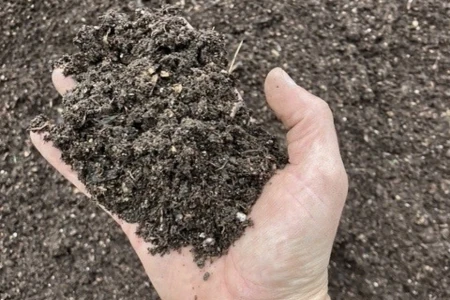
Finished compost is dark brown, crumbly, and earthy smelling.
- When the temperature of the pile drops, the compost enters its curing phase. This is when other organisms move in and populate the organic matter, breaking it down further and creating a finer texture. At this point, the pile can be turned one or two more times until the desired texture is reached.
- It typically takes three to six months for a backyard bin-style compost pile to break down into finished compost. The speed of decomposition depends on many factors, including the materials used, time of year, size of the pile, and how often it's turned.
- Finished compost is dark brown, crumbly, earthy smelling, and no longer resembles the materials that were originally added to the pile. The temperature should be near ambient conditions and the material should not produce unpleasant odors.
A Note on Safety
Composting is an amazing natural process, but there are a few things to keep in mind to ensure that it is done safely and effectively. Before starting to compost, it is important to realize that there are risks associated with food safety, heat (fire), and worker health.
Food Safety
Proper management of composts containing manure or post-consumer food waste is critical to prevent potential spread of foodborne illness. To ensure these materials are handled safely, the USDA National Organic Program has set guidelines for compost production 3 that several food safety certifications accept:
- Carbon to nitrogen ratio of pile must be between 25:1 and 40:1.
- Temperature must be maintained between 131–170°F (55°–77°C) for:
- 15 days with 5 turns for turned pile/windrow systems
- 3 consecutive days for static aerated systems
- Records of feedstocks, ratios, temperatures, and turns must be documented.
Heat (fire)
Large compost piles can generate significant heat and, under certain conditions, may pose a fire risk. Maintaining adequate moisture and properly managing pile size greatly reduces this risk.
Worker Safety
Compost can be dusty and contain materials that can be irritants or pose health risks to humans. Proper PPE (personal protective equipment) should be worn when handling feedstocks or finished compost. Respirators and gloves are simple forms of PPE that should be worn when working with compost.
Learn More
References Cited
- Importance of Methane, EPA
- Composting, EPA
- Conservation Practice Standard Composting Facility CODE 317, USDA