

- Acorn Winter Squash | Key Growing Information
- The Winter Squash Eating Experience | Basic Differences in Eating Quality Between 7 Types
- Butternut Winter Squash | Key Growing Information
- Delicata & Sweet Dumpling Winter Squash | Key Growing Information
- Understanding Flavor & Yield in Winter Squash | Why Some Varieties Just Taste Better Than Others
- How to Choose Fall Cucurbits | Edible, Ornamental & Dual-Purpose Pumpkins, Squash & Gourds
- Hubbard Winter Squash | Key Growing Information
- Kabocha Winter Squash | Key Growing Information
- Spaghetti Winter Squash | Key Growing Information
- Greenhouse Cucumbers: Trends & Varieties | Johnny's Webinar Series
- Miso-Glazed Kabocha Squash Recipe
- Winter Squash Varieties | Comparison Chart (PDF)
- Winter Squash | Key Growing Information
- Winter Squash Production | Tech Sheet (PDF)
- Curing & Storage Chart for Different Kinds of Winter Squash
- 'Block Party' Butternut Squash Variety Bred by Johnny's Selected Seeds
- Classic Storage Crops | Post-Harvest Handling & Storage Guidelines
- Cucumber Beetle Lure Instructions | Tech Sheet (PDF)
- 'Night Shift' Acorn Squash | Bred by Johnny's
- 'Marmalade' Kabocha Squash | Bred by Johnny's
- 'Honey Bun' Sweet Dumpling Squash Bred by Johnny's
- Squash Success: From Seed to Storage with Johnny’s | Johnny's Webinar Series
- Squash Success: From Seed to Storage | Webinar Recording
- 'Mambo' Winter Squash Variety Bred by Johnny's Selected Seeds
- Buttercup Winter Squash | Key Growing Information
The Winter Squash Eating Experience: Differences Between 7 Types
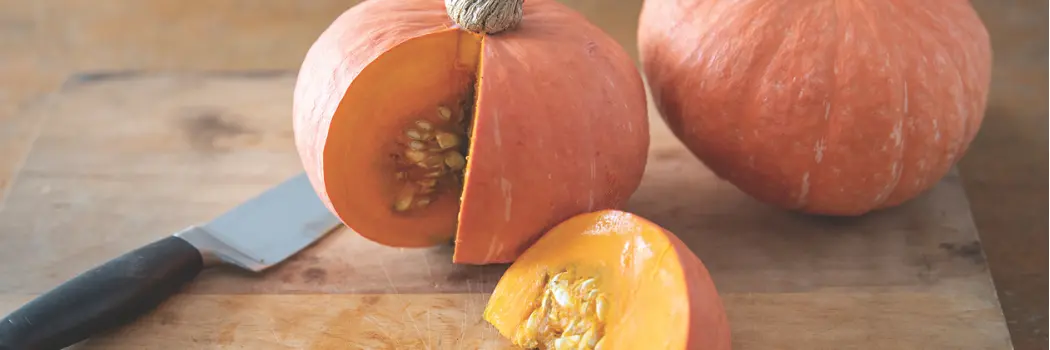
Above: 'Marmalade' kabocha squash.
By Pete Zuck, former Product Manager, with updates by Nate Gorlin-Crenshaw, current Product Manager for Winter Squash
On This Page
To help differentiate the eating experience that each type of winter squash provides, we've compiled an overview of the main types Johnny's offers. We've highlighted some personal favorites from the Research Team as well, hoping to inspire you to try something new. Scroll down for a look at our "menu"!
- What do we mean by eating quality? In a nutshell, three main factors that affect eating quality are: sugar content, dry matter, and aromatics, which affect the sweetness, texture, and flavor of the squash accordingly. Learn more about the variables that contribute to culinary excellence in our article Understanding Flavor & Yield in Winter Squash.
- How to cure and how long to store for peak flavor: Different kinds of winter squash vary as to how long they take to cure after harvesting, and how long before they achieve peak eating quality. Use our Winter Squash Storage Chart to understand the optimal curing and storage periods for the various types. This should help you plan ahead, and enable you and your customers to enjoy each type at the pinnacle of its eating quality.
1 • Acorn
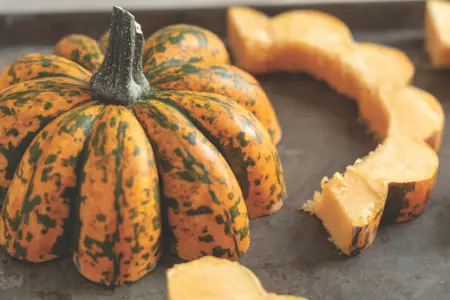
Compared to industry-standard green acorns, 'Starry Night' has superior flavor and storage potential, storing well through the holidays.
Acorns are great for experiencing the first taste of roasted winter squash as the first chill of fall creeps in. Unlike most butternuts, buttercups, and kabochas, they do not store well, and their peak eating quality is reached within 6–8 weeks of harvest. The exceptions are 'Starry Night,' and 'Night Shift,' Johnny's-bred organic acorns that are exceptional in many ways, including their ability to retain excellent eating quality right through the New Year. Split them down the middle, fill each half with a dollop of butter and a spoonful of maple syrup, roast and enjoy while you ponder the coming of another winter. Simple.
2 • Buttercup
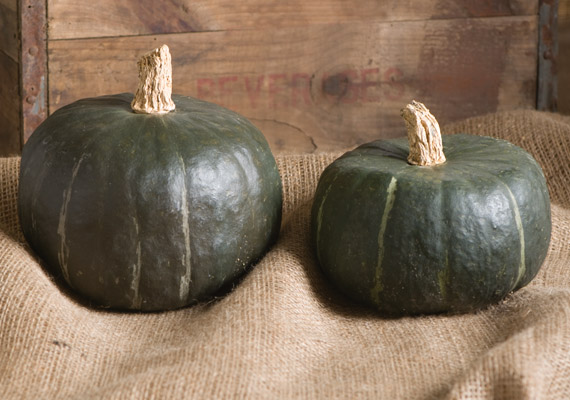
Buttercups pair nicely with other flavors and textures, such as apples, grains, nuts, and cheeses.
For those outside of New England and parts of the midwest, the buttercup squash may be less familiar. At a basic level, it is a lot like a kabocha with a belly button—but generally a little larger, a little moister, and not as nuanced in terms of flavor. These qualities allow buttercups to pair nicely with other flavors and textures, such as apples, grains, nuts, and cheeses. Johnny's 'Bonbon' is one of the best out there, with exceptional sweetness and a great flakey texture.
3 • Butternut
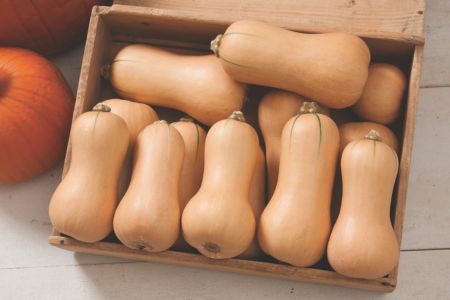
Butternuts are the ideal "ingredient" squash. While they are perfectly fine roasted on their own with a little butter and salt, their smooth, moist texture and uncomplicated sweetness make them the perfect base for pies, soups, curries—you name it, butternuts can adapt to the recipe.
For those looking for a big, beautiful butternut, “Block Party’s” shape offers advantages in the kitchen: its thick neck means less waste when preparing or processing and it has a good flesh to seed cavity ratio- all with our usual commitment to sweet, flavorful squash. For those looking for something with a more managable size, Johnny's has bred two mid-size workhorse butternuts with high sugars: 'Metro PMR' and 'JWS 6823 PMR'. They also feature good powdery mildew resistance (PMR) and short vines that professional growers will appreciate. Our 2014
4 • Delicata/Dumpling
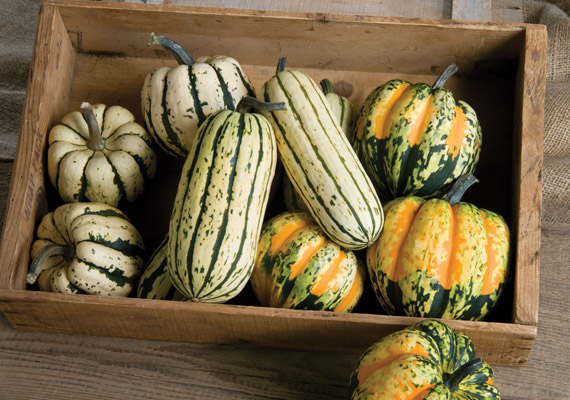
Delicatas are generally sweeter than acorn squash and have a very thin, skin that is edible when cooked
These are the most delectable of the pepo squashes, often much sweeter than their close cousins, the green acorns. Delicatas in particular are wonderful to eat because they have very thin, edible skin when cooked; you don't have to bother with peeling them. Dumpling squash have similarly sweet flavor in a slightly smaller package. 'Honey Bun' is a JSS-bred dumpling squash that offers a dramatic improvement over 'Sweet Dumpling' in terms of yield, storability, and flavor. The fruits turn caramel-bronze at peak ripeness, acting as an excellent harvest indicator.
5 • Hubbard
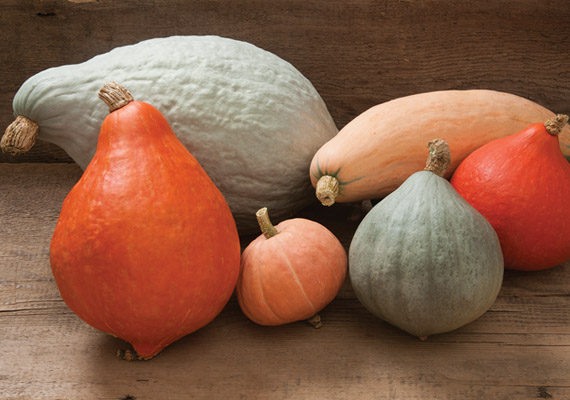
Hubbard squash are great for soups, ravioli stuffing, and other utilitarian purposes when you require a large quantity of squash flesh with mild flavor.
Hubbards are an old tradition, and they are great for soups, ravioli stuffing, and other utilitarian purposes when you require a large quantity of squash flesh with mild flavor. We grouped 'North Georgia Candy Roaster' with the hubbards because it is a maxima squash, but the 'Roaster' boasts much better flavor than the true hubbards. For a quick dessert, try this: split a 'Candy Roaster' lengthwise, deseed it, pour pumpkin pie filling right into the two halves, and bake it. It is fantastic!
6 • Kabocha
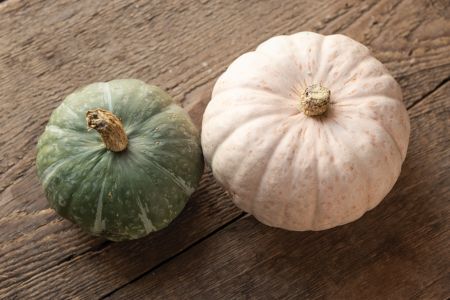
Our former Product Manager for squash, Pete Zuck, considered kabocha to be the pinnacle of winter squash, and was known to carry on ad infinitum about them—the dry, flaky texture; the incomparable sweetness; the complex flavor; the edible skin; the incredibly long storage…! Kabocha is the winter squash of record in Japan, and "I'm happy to see it finally gaining more popularity here in the US" reports Nate Gorlin-Crenshaw, Johnny's Product Manager for squash. Kabocha texture is more like that of a good roasted potato: drier, and more flakey and fluffy than other squash types. If you are among those who think that squash eats like baby food, you will find this type to be a welcome change. A few of us at the Johnny's Research Farm keep personal stashes of 'Winter Sweet', and around the first of February it starts showing up in the lunchroom. If you have not roasted a properly cured kabocha squash on a cold winter night, you are really missing out—here's one of Pete's favorite recipes! For those who can't wait until February before taking their first bite of Kabocha, 'Sunshine' is excellent even fresh out of the field!
Kabocha hais long been a particular area of focus for our classical Breeding Team. The aforementioned Johnny’s-bred ‘Sunshine’ was the All America Selections (AAS) winner in 2004 and has since become widely known. In 2023, Johnny’s was again an AAS winner with ‘Sweet Jade’, an adorable personal-sized kabocha.
7 • Spaghetti
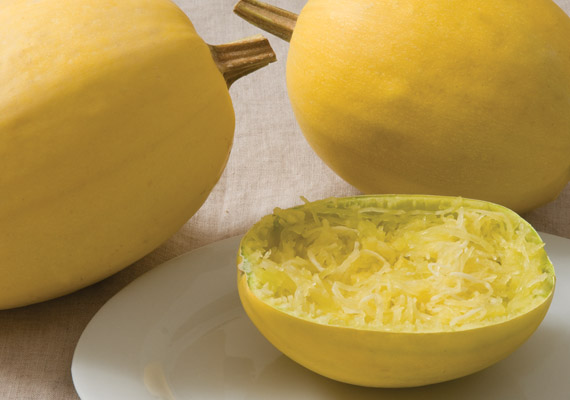
Spaghetti squash: the classic pasta alternative
Spaghetti squash has enjoyed a rapid rise in popularity as a whole-food alternative to pasta. While spaghetti squash has lower nutritional density and less longevity in storage than most other winter squashes, its carbohydrate profile and ability to blend seamlessly with sauces and oils make it a versatile choice for easy meals that won't slow you down. It's great with pesto.
Learn More
If you'd like to learn more about what makes different squashes a unique and enjoyable eating experience, here are a few more resources:
- Pete's Miso-Glazed Kabocha Squash Recipe • Video
- Winter Squash Storage Guide • Chart of Peak Flavor, Curing & Storage Times
- Winter Squash & Edible Pumpkins • Why Some Varieties Taste Better Than Others • Article
- Winter Squash Varieties • Comparison Chart (PDF)
- View All Our Winter Squash Varieties • Product Listing