

- Seed-Starting Date Calculator: When to Start Seeds Indoors | Johnny's Selected Seeds
- Seed-starting Methods at Johnny's Greenhouses | 3 Systems for Starting Professional-Quality Seedlings Indoors
- Starting Flowers from Seed
- Guidelines for Starting Seeds Indoors | Tips & Troubleshooting Advice for Starting Healthy Seedlings
- Transplanted Vegetable Crops | Plant Quantity & Average Yield Chart + Feet of Row per Acre
- Transplanted Vegetable Crop Yield Chart | Number of Plants Yielded per Seed Quantity & Average Harvest Yield
- Johnny's 512 Mix | Instructions for Using Our Compost-Based Growing Mix
- Johnny's 50-Cell Commercial Soil Blocker | Use & Maintenance | Tech Sheet (PDF)
- Johnny's 12-Cell Handheld Soil Blocker | Use & Maintenance | Tech Sheet (PDF)
- Johnny's Drop Seeder | Assembly & Use | Tech Sheet (PDF)
- Johnny's 72-Cell Commercial Soil Blocker | Use & Maintenance | Tech Sheet (PDF)
- Soil-Block Makers | Instructions & Blocking Mix Recipe | Tech Sheet (PDF)
- Johnny's 10-Cell Handheld Soil Blocker | Use & Maintenance | Tech Sheet (PDF)
- Discovering Soil-Block Making, by Eliot Coleman
- Video: How to Start Your Seeds with Soil-Block Makers
- Video: About Pelleted Seed
- Guide to Choosing a Grow Light | Tech Sheet (PDF)
- Strip Grow Lights & Accessories | LED & T5HO | Comparison Chart (PDF)
- 4' LED Propagation Rack Kit | Assembly & Use Instructions | Tech Sheet (PDF)
- How to Grow Healthy Hydroponic Seedlings | Seed-Starting & Environmental Variables
- Bioset Germinator & Bioset Germinator Kit Instructions | Tech Sheet (PDF)
- Deluxe LED Microgreens Starter Kit Instructions | Tech Sheet (PDF)
- Basic Microgreens Starter Kit Instructions | Tech Sheet (PDF)
- Deluxe Microgreens Starter Kit Instructions | Tech Sheet (PDF)
- Seedling Grower Starter Kit Instructions | Tech Sheet (PDF)
- Manual Leek Planter | Instruction Sheet (PDF)
- Paperpot Drop Seeder Plates | Comparison Chart (PDF)
- Terrateck Paperpot Transplanter | Assembly Instructions | Tech Sheet (PDF)
- Terrateck Paperpot Transplanter | Instructions for Use | Tech Sheet (PDF)
- Paperpot Transplanter | Paper Chain Pots | Comparison Chart (PDF)
- Precision Vacuum Seeder | Instruction Manual (PDF)
- Precision Vacuum Seeder | Interchangeable Plates | Comparison Chart (PDF)
- Precision Vacuum Seeder | Supplemental Instructions | Identifying Your Tray Brand (PDF)
- Precision Vacuum Seeder Trial Results | Plate Recommendations for Flowers & Ornamentals (XLSX)
- Precision Vacuum Seeder Trial Results | Plate Recommendations for Herbs (XLSX)
- Precision Vacuum Seeder Trial Results | Plate Recommendations for Vegetables (XLSX)
- SunBlaster Spectrum Test Report - SBH 4' LED 6400K @ 6" | Tech Sheet (PDF)
- SunBlaster LED Strip Light Operating Manual | English (PDF)
- Strip Light Stand Instructions | Tech Sheet (PDF)
- SunBlaster LED Strip Light Operating Manual | Français (PDF)
- Sunblaster T5HO Comparison to Sunblaster LED Grow Lights | Tech Sheet (PDF)
- SunBlaster Light Timer Instructions | Tech Sheet (PDF)
- SunBlaster Growlight Garden Instructions (PDF)
- Seedling Light Carts | Assembly Instructions (PDF)
- Smart Pots | Comparison Chart (PDF)
- Video: How to Seed Your Paperchain Pots & Trays
- Video: Paperpot Transplanter Demonstration
- Video: Plug Popper | Quick Demo
- Video: How to Use the Precision Vacuum Seeder
- Video: Winter Sowing & Milk-Jug Greenhouses | With Niki Jabbour & Johnny's
- Video: Growing Tomatoes in Containers with Niki Jabbour & Johnny's
- Video: Growing Peppers in Containers with Niki Jabbour & Johnny's
- Video: Direct-Seeding Your Garden | Tips & Recommendations with Niki Jabbour
- Flower Seed Starting Fundamentals
- Johnny's 12-Cell Handheld Soil Blocker
- RootShield Plus+ WP | Wettable Powder | Label
- RootShield Plus+ WP | Wettable Powder | MSDS
- RootShield Plus+ WP | Wettable Powder | OMRI Certificate
- Seeding Date Calculator | To Target Specific Harvest Dates | Johnny's Selected Seeds
- Flower Seed Starting Fundamentals
- Starting Seeds in the Johnny's 12-Cell Handheld Soil Blocker
- Connecta® Row Pro™ Hiller/Furrower | Connecta Tool System
- Johnny's Paperpot Transplanter | Assembly & Instruction Manual (PDF)
- Paper Chain Pots | WSDA Certificate (PDF)
- Hardening Off Seedlings With Niki Jabbour
- Soil Blocking: A Better Way to Start Seedlings
- How to Use the Johnny's 72-Cell Soil Blocker
- Johnny's Hand Transplanter | Instruction Manual (PDF)
- How to Make Soil Blocks + The Advantages of Soil Blocking With Niki Jabbour
- Johnny's 32-Cell Handheld Soil Blocker | Manual | Tech Sheet (PDF)
- Video: Manual Cell Tray Seeder | from Johnny's Selected Seeds
- Johnny's Hand Transplanter & Caddy
- Johnny's Infinite Adjustable LED Light Stand | Assembly & Use | Tech Sheet (PDF)
- Johnny's Modular LED Grow Light Cart | Assembly & Instruction Manual (PDF)
- JSS Commercial 9-Tray LED Light Cart | Instruction Manual (PDF)
- Johnny's Commercial LED Light Cart | Assembly & Instruction Manual (PDF)
- Johnny's 72-cell Soil Blocker (Quick Demo)
- Johnny's 10-Cell Handheld Soil Blocker
- Soil Blocker ROI Calculator
- Connecta® Matrix™ Row Marker | Connecta Tool System
- Fertil Pots | OMRI Certificate
- Seed-Starting Flats, Trays, Domes & Pots | Comparison Chart (PDF)
- Johnny's Paperpot Transplanter
- Bloom to Boom: Flower Farm Profitability
Starting Flowers from Seed
By Joy Longfellow, Flowers Product Technician, Johnny's Selected Seeds
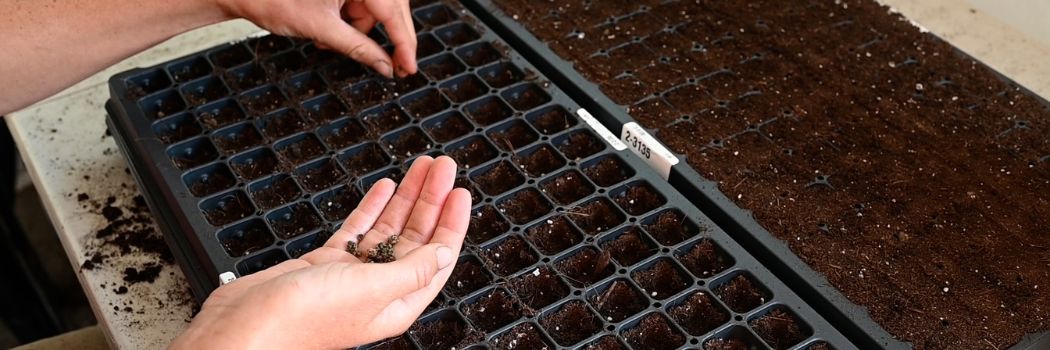
The basic best practices of seed starting apply across all seed crops, but there are also some specific tips and techniques that can help assure success in starting flower crops from seed. In this article we will provide detailed guidance on starting 9 popular cut-flower crops from seed.
Why Start Flower Seeds Indoors?
There are several benefits to growing your own flower seedlings instead of buying starts. Starting your own flower seeds gives you access to a wider selection of varieties and more control over the color palette of your cuts. When compared to direct seeding, starting seeds indoors is a favorable option for flower crops with slow germination and longer seedling development.
Seed Starting Best Practices
We encourage you to review our Guidelines for Starting Seeds Indoors for a thorough review of essential best practices applicable to all seed crops, including flowers. Then, read on for more flower-specific information.
A Note About Pelleted Seeds
Pelleting is a seed enhancement that coats the seeds with inert substances that render them uniform in size and shape. Pelleting is a process often applied to very small seeds, as the pellet coating serves to improve seed visibility, handling, sowing accuracy and efficiency, thereby reducing seed waste and the need for thinning. Examples of flower crops that Johnny’s offers in pelleted seed include: campanula, dianthus, digitalis, lisianthus, and snapdragon. While pelleting offers many advantages, the process and nature of pelleting may shorten the shelf life of the seed. We recommend using pelleted seed within one year of purchase. If you need to store pelleted seeds until planting, protect them from heat and humidity by placing them in a cool, dark, dry place. If you prefer to store your seed in the refrigerator, place the seed in an air-tight container to protect it from fluctuations in humidity.
Reading Your Flower Seed Packet
Essential germination conditions and planting instructions are listed on each packet and online in our flower key growing information pages. As you review these growing resources, it may be helpful to note the following.
Front of the Seed Packet
- For all flower crops, we list days to maturity as the number of days from seeding date (regardless of whether you are direct seeding or transplanting).
For flowers, that is the estimated length of time from seeding to harvest for cut flowers. We consider maturity when 25-50% of the plot is flowering. The days to maturity that we list in our growing instructions is based on multi-year data collection from our trial fields. - You will also be able to see the germination test results on the seed packet; this number sets the baseline for what you can expect for seed germination under appropriate conditions.
Back of the Seed Packet
- In the culture, we will note if transplanting or direct seeding is preferred.
- We provide the estimated time in trays from seedling to transplant. This is a range, as the time can vary with environmental conditions and the tray cell size used.
- We provide the expected number of days to germination and the optimum temperature range for germination. If grown outside of the recommended temperature range, seeds may still germinate but germination may be slower or at a lower percentage than expected.
- For most flower crops, the recommended temperature for growing on (growth after initial seed germination) is lower than the recommended temperature for germination. Adjust your conditions appropriately.
Breaking Seed Dormancy
Some crops need some extra encouragement to break dormancy and germinate. Generally, these crops need some special care in regards to light or temperature control:
- Light (or Darkness Requirements:
Some flower crops require light or darkness for germination. We note these requirements in the growing instructions.
Requires light: For these crops, make sure the seeds have some exposure to light and are not in complete darkness. Place trays under grow lights until the seeds germinate. Even for crops that require light to germinate, we still cover the seeds lightly with vermiculite to help retain moisture. Some flower crops that require light to germinate are: ageratum, alyssum, rudbeckia, dusty miller, matricaria, and lisianthus.
Requires darkness: Some flower crops require darkness for germination. Either cover the seed completely with potting mix or keep seedling trays in dark conditions until germination occurs. Examples of flower crops that require darkness include phlox and nasturtium. - Cold Stratification
Cold stratification is the process of exposing seeds to cold temperatures for a period of time in order to break seed dormancy and promote germination. Most flower crops, especially annuals, do not require cold stratification. For crops where cold stratification is necessary, we indicate the ideal temperature range and length of time for cold exposure. For example, the growing instructions for Rudbeckia triloba recommend prechilling the seeds in the refrigerator for 30 days prior to seeding.
Soaking Seeds
Soaking seeds before planting is not necessary for most crops. For those crops, like sweet peas, where it can be helpful, we include soaking recommendations in the growing instructions.
Tray Selection for Flower Crops
There are many options for starting seeds, including soil blocks, biodegradable pots, and plastic pots/trays. To learn more about the pros and cons of these different methods, review our article Three Systems for Indoor Seed Starting.
At the Johnny’s Research Farm, we start thousands of flower seedlings each year. At this scale, we’ve found plastic trays work best for us.
When deciding on which tray cell size to use, consider the size of the seed and how long the crop is expected to be in trays. We use different cell sizes for different crops and situations; here’s a rundown of what works for us:
20-row flats (a.k.a. strip trays)
These are a helpful option early in the season if heated growing space is limited. You can start different varieties in each strip, allowing you to start a lot of varieties in a small space. These are also good if the germination rate is unknown or suspected to be low. Strip trays are best for small-seeded crops and crops that can tolerate some root disturbance, as the seedlings will have to get bumped up to a larger cell size before they will be ready to transplant out.
Note that these are shallow trays that can dry out quickly; as such they are not appropriate for crops with large seeds or taproots. It is imperative that you bump up seedlings before they become rootbound.
128 cell plug flats
This is a standard plug flat that is useful for many flower crops with small to medium sized seed. 128’s are a good balance between efficient use of soil and space while also providing a cell size that allows for a full-size seedling to develop without the need for bumping up.
72-cell and 50-cell trays
We use these larger cells for medium to large-seeded crops and for fast-growing crops that outgrow 128 cell trays too quickly. Since the cell sizes are larger, these trays allow a little longer for seedling growth and some flexibility around transplant time.
Deep 50 cell trays
The Deep 50 cell trays have extra-deep cells for crops with long tap roots and/or a long development time. This cell size helps keep seedlings from becoming rootbound, however, the larger cell size can make it a bit more time consuming to transplant seedlings.
Seeds Per Cell (Seeding Density)
We typically seed 1-2 seeds per cell. Seeding more densely than that can result in poor airflow and increased risk of disease. We thin to 1 plant per cell following germination.
Growing Resources by Crop
Lisianthus
Snapdragon
Celosia
Eucalyptus
Delphinium
Echinops
Echinacea
Sweet Pea
Stock
Pinching Seedlings in the Tray
Pinching is the process of removing the central growing tip to promote growth of sideshoots. For some flower crops, pinching is helpful in increasing plant productivity. Pinching is not recommended for all flower crops; check the growing instructions for guidance on whether or not to pinch.
For crops where pinching is beneficial, we sometimes pinch seedlings while they are still in trays. Typically, we do this if we know we aren’t going to be able to transplant in a timely manner and we know we are going to pinch them eventually anyway; in this situation we may pinch in the trays to slow down the plant growth and to ensure we don’t miss the appropriate window for pinching. Snapdragon, zinnia, cosmos and celosia are all crops where we have sometimes chosen to pinch in the tray. While inching in the trays is not standard practice for us, it is a helpful option sometimes.
Common Seed Starting Problems
Review our Guidelines on Seed Starting Indoors for advice on avoiding common problems such as damping off (sudden death of seedlings); stretching and legginess; and rootbound plants.