

- Crop Rotations for Cut-Flowers in the Tunnel
- 3 Sunflower Succession Planting Programs for Maximum Quality & Yield
- Succession Planting Charts for Vegetables
- Succession-Planting Flowers | Scheduling & Planning, Sowing Frequency, Record Keeping & Recommendations
- Succession-Planting Interval Chart for Herbs
- Leek Varieties | Harvesting Program Comparison Chart | Johnny's Selected Seeds
- Raspberry Harvesting Program
- Strawberry Succession Harvesting Program
- Mini & Sprouting Broccoli Varieties | Planting Program Comparison Chart
- Cauliflower Varieties | Planting Program Comparison Chart & Blanching Tips
- Lettuce | Full Head Varieties | Succession Planting Program
- Planting a Fall Garden Bed • Mid-Summer Succession Planting
- Succession Planting Principles & Practices: Methods for Ensuring a Continuous Supply
- Blackberry Harvesting Program
- Broccoli | Standard Heading Varieties | Planting Program Comparison Chart
- Radicchio Varieties | Succession Planting Program
- Radish | Specialty & Daikon/Korean Varieties | Planting Program Comparison Chart
- Recommended Crops for Succession Planting
- Succession-Planting Interval Chart for Flowers
- Blueberry Harvesting Program
- Tulip Harvesting Program
- Succession-Planting Calculator (XLSX) | Johnny's Selected Seeds
- Brussels Sprouts Harvesting Program Comparison Chart
- Spinach Varieties | Succession Planting Program
- Johnny's Planting & Harvesting Programs
Succession Planting • Principles & Practices
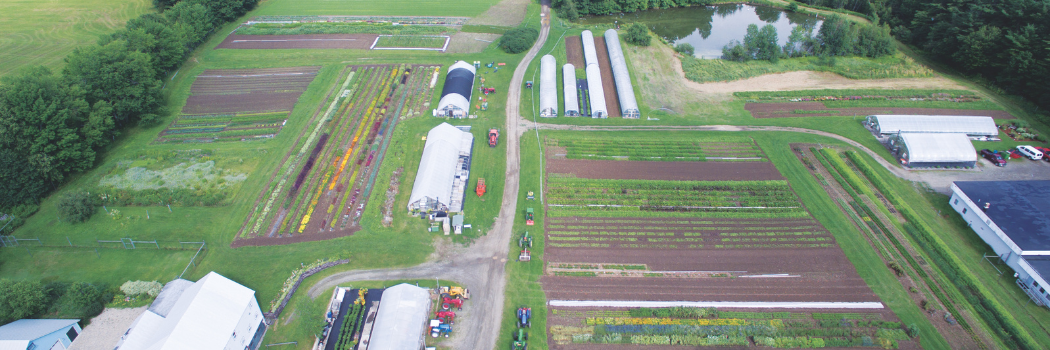
Above: Aerial view of the Johnny's Research Farm.
Succession Planting is the application of strategies to ensure a continuous supply of garden produce throughout the growing season. Here we discuss 4 key strategies for achieving an extended harvest—from the very earliest possible date right through to the very latest.
Advantages of Succession Planting
Putting the principles of succession planting into practice takes some of the guesswork out of planning and results in a steadier supply of produce—ready for harvest over the longest possible period. Succession planting gives you the ability to:
- Maximize space
- Extend the harvest window
- Maintain a continuous supply
- Optimize quality and yield
4 Key Strategies
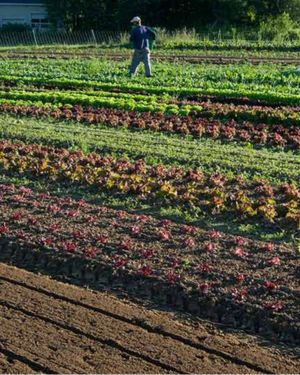
We start with the simplest method and proceed to the more evolved. As you keep records and gain experience, you can combine methods, adopt those of others, and innovate your own to achieve even greater results.
1 • INTERVAL PLANTING
Same variety, same crop, sown at successive intervals.
Selecting Crops for Interval Planting
Some crops are particularly well suited for successional plantings throughout the growing season because of their relatively short time to maturity. Timing of sequential plantings is based on the average days to maturity (DTM), assuming standard growing practices. For example, fast-growing greens might be sown every 7 days while summer squash might be sown every 30 days. For a list of crops and their recommended succession intervals, refer to our interval charts:
Calculating Interval Seeding Dates
To forecast seeding dates, try our Succession-Planting Calculator. You can use this calculator to determine dates for sequential, staggered plantings—whether counting forward from last regional frost date in spring or backwards from first regional frost date in fall.
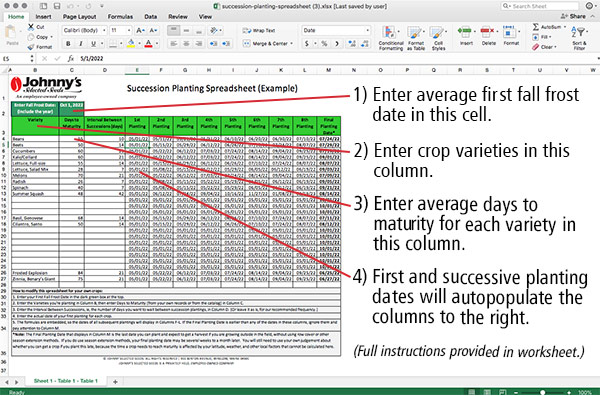
Johnny's Succession-Planting Calculator (XLSX)
Input your first frost date and the average days to maturity (DTM) for your chosen variety, and the calculator will display appropriate dates for sequential plantings.
Keep in mind that local frost dates, latitude, growing zone, climatic variables, and cultural methods will influence days to maturity. After midsummer, for instance, growers at most latitudes start timing successive plantings more closely together, as crops will mature more slowly as the days grow shorter and cooler. Good recordkeeping during the growing season can help you home in on the ideal planting schedule for your location and growing conditions.
Interval Planting + Indoor Seed Starting
You can combine indoor seed-starting with direct-seeding to maximize the number of successions you can achieve. This simply requires starting seeds indoors for many crops you might normally direct-seed, such as arugula, cilantro, cucumbers, parsley, spinach, squash, and sunflowers. When you transplant the seedlings outside, you can complete your direct-seeded planting. The transplanted crop will be ready for harvest first, followed by the first direct-seeded planting a few weeks later.
2 • HARVESTING PROGRAMS
Same crop, different varieties with differing maturity dates, sown concurrently
Many seed crops are bred and selected for particular traits such as heat or cold tolerance or ability to thrive under lower or higher light conditions. Within a particular crop, some varieties perform better in cool weather and others in warm weather, some under increasing daylength and others under decreasing daylength. If you grow only one variety of a crop, you may find it falls short of its potential at some point or another during the season.
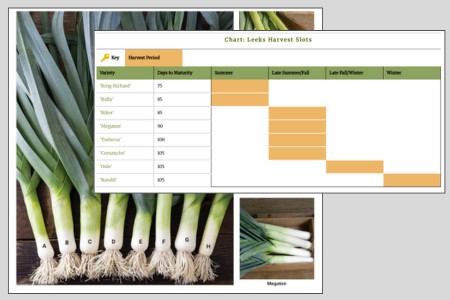
By growing several varieties, you can span a longer season and still offer consistently high quality produce. Our harvesting programs recommend sowing multiple varieties with different days-to-maturity (DTM) to spread the harvest across time from a single planting.
For example, our leek harvesting program involves concurrently planting several leek varieties that require from 75 to 120 days to mature, to allow you to successively harvest leeks from summer through fall to winter.
Harvest programs are also a primary way of extending the harvest window for perennial crops such as berries.
Explore our harvesting programs:
- Blackberry • Harvest Program
- Blueberry • Harvest Program
- Brussels Sprouts • Harvest Program
- Leeks • Harvest Program
- Raspberry • Harvest Program
- Strawberry • Harvest Program
3 • PLANTING PROGRAMS
Same crop, different varieties with differing seasonal adaptations, sown successively
Our planting programs recommend sowing different varieties with different days-to-maturity (DTM) and differing seasonal adaptability, at different times of the year.
Planting programs, especially when combined with season-extension techniques, can allow for the maximal harvest window across time. For example, to achieve a long harvest window of broccoli, one might plant one variety in spring and a different variety in summer, and in so doing, achieve a continuous harvest from summer through late fall.
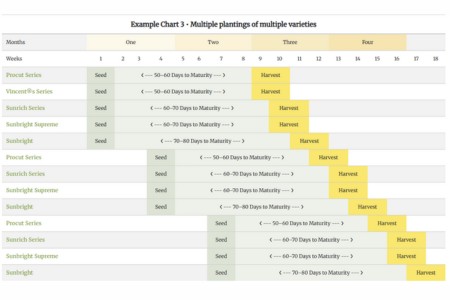
Our Sunflower Charts nicely demonstrate how all three of the above strategies—interval planting, harvesting program, and planting program—can be creatively combined to make the most of succession-planting concepts.
Visit the Planting Program section of the Grower's Library for details on implementing these programs:
4 • SEASON EXTENSION TECHNOLOGY
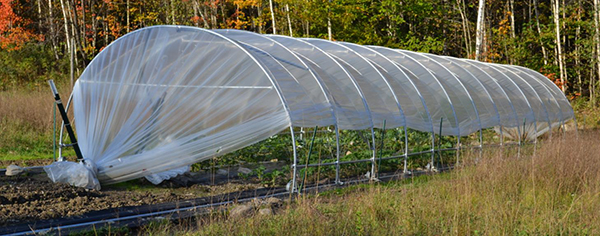
Finally, protected cropping bears mention as it can significantly expand the limits of your growing season, allowing for production earlier in spring, later into fall and winter. You can tailor the protection to the crop and anticipated frost dates.
- Protect Your Crops
- Winter Growing Guide
- Overwintering Flowers Guide
Visit our Season Extension & Winter Growing Library to learn more.
Linking It All Together
Succession planting may seem complicated at first, but with practice you'll get the swing of it. Start with a few main crops and project your harvest dates, then use these four key strategies to find further opportunities to extend the harvest.
Keep track of the details, then analyze the results. You'll soon be on your way to creating a succession-planting system that provides for abundance and quality—and strong sales—over the longest possible season.
Succession-Planting Resources from Johnny's
- Recommended Crops for Succession Planting (Veg, Herbs & Flowers) • Tables
- Planting Intervals for VEGETABLES • Charts
- Planting Intervals for HERBS • Charts
- Planting Intervals for FLOWERS • Charts
- Succession-Planting CALCULATOR • XLSX
- Johnny's Planting & Harvesting Programs • Charts