

- 3 Easy, Reliable, Productive Cut Flowers: Sunflowers, Zinnias & Rudbeckia
- 5 Factors That Determine Vase Life of Cut Flowers
- 2019 American Flowers Week: Combining the Art of Floral Design & Couture
- Celebrating the 8th American Flowers Week | Johnny's 2022 Botanical Couture
- Celebrate the 7th American Flowers Week | Johnny's 2021 Botanical Couture
- Collective Selling Models for Flower Farmers: Flower Hubs That Work
- 5 Cool Flowers to Plant Now | Lisa Mason Ziegler's Secrets for Growing Hardy, Cool-Season Annuals
- Cut-Flower Harvesting & Post-Harvest Care | Best Practices from Pros in the Slow Flower Community
- Cut-Flower Kit | Guide for Market Growers (PDF)
- Easy Cut-Flower Garden Map | For Growers New to Flowers (PDF)
- Easy Cut-Flower Garden Planner | For Growers New to Flowers (PDF)
- From Color to Climate: 5 Floricultural Trends Subtle & Seismic
- Flower Culture by Crop | Comparison Chart | Days to Germination, Weeks to Transplant, Days to Harvest (PDF)
- Flower Farmers' Favorite Fillers & Foliage | Recommendations from 3 Farmer-Florists
- Getting Started in Cut-Flowers | Top 15 Cuts
- Heat & Drought: How Flower Farmers Are Adapting to Changing & Challenging Climatic Conditions
- Introduction to Overwintering Flowers | Guide to Overwintering Flowers
- An Introduction to Producer Marketing Cooperatives | M Lund & Associates
- How Day Length Affects Cut-Flower Production
- Growing Flowers in Hoophouses & High Tunnels: Cool-Weather & Hot-Weather Options
- Crop Rotations for Cut-Flowers in the Tunnel
- Starting a U-Pick Flower Farm, From A-to-Z
- Roadside Flower Stand Basics: Success Tips for On-Farm Retail
- Growing Flower Seedlings for Profit
- Year-Round Flower Production Strategy
- Overwinter Flower Trials | Multiyear Results for 30+ Crops | Johnny's Selected Seeds | XLSX
- Seeding Date Calculator | Johnny's Recommended Flowers for Overwintering | XLSX
- Just Add Flowers | An Introduction to Companion Planting for Vegetable & Herb Gardeners
- Pricing & Profitability for Flower-Farmers | Pointers from a Diversity of Pros
- Sustainable Farming Methods | A Survey of Flower Farmers' Best Practices
- Slow Flowers Palette & Petal Crushes | Evolving Colors & Shape-Shifts in Floral Industry Trends
- Johnny's and Slow Flowers | Johnny's Selected Seeds
- Slow Flowers | Celebrating Fifth-Season Regional Design Elements
- Slow Flowers Floral Forecast | A Summary of Industry Insights & Trends
- Building a Better Market Bouquet: Tips, Techniques & Recipes for Flower Farmers
- Slow Flowers | Tips for Staging On-Farm Floral Workshops | Johnny's Selected Seeds
- Wedding Wisdom 101 | 10 Beginner Tips for Entering the Wedding Floral Landscape
- Succession-Planting Flowers | Scheduling & Planning, Sowing Frequency, Record Keeping & Recommendations
- Succession-Planting Interval Chart for Flowers
- Sustainable Floral Design | Techniques & Mechanics for Foam-Free Floristry | Tobey Nelson & Debra Prinzing
- Mason Jar Bouquet Tutorial
- How to Build a Bouquet
- Tobey Nelson | Sustainable Floral Design | Slow Flowers Summit
- Economic Considerations in Overwintering Cut Flowers
- Top 10 Cut-Flower Varieties for Direct Seeding
- Floating Row Cover | Baby "Cool Flower" Protection from Whipping Winter Winds
- The Procona System for All-in-one Flower Harvest, Transport & Display
- Johnny's Overwinter Flowers Tunnel: Trellising, Supports, Ground Cover & Spacing
- Irrigation Considerations for the Overwinter Flowers Tunnel
- Johnny's Overwinter Flowers Trial Recap
- Producer Cooperatives for Small-Scale Farmers | Webinar Recording
- Climate Adaptation for Vegetable & Flower Farmers | Johnny's Educational Webinar Resources
- Floral Standards for Flower Farm Collectives and Cooperatives
- Chrysal Professional 2 Transport & Display T-Bag | SDS
- Eat Your Flowers: Serve Up That Wow Factor With Edible Flowers
- When to Start Seeds for Overwintered Flowers | Guide to Overwintering Flowers
- Introduction to Forcing Flower Bulbs in Soil | Guide to Forcing Flower Bulbs
- Flower Growing in Southern States | Webinar Recording
- Chrysal Clear Bulb Flower Conditioner | SDS
- Chrysal Professional 1 Hydration Solution | SDS
- Webinar Slide Deck | U-Pick Power for Your Flower Farm | PDF
- Bloom to Boom: Flower Farm Profitability
- Choosing Flower Crops to Overwinter | Guide to Overwintering Flowers
- Webinar Slide Deck | New-for-2023 Flowers & Floral Supplies | PDF
- Chrysal Classic Professional 2 Transport & Display (Holding) Solution | SDS
- Flowering in the South: Profiles of 5 flower farmers who cope with temperature, humidity, pest & weed pressure
- Chrysal Professional 3 Vase Solution Powder | SDS
- Edible Flowers List: Top 20 Favorites from the Slow Flowers Community
- U-Pick Power for Your Flower Farm | Johnny's Webinar Series
- Webinar Slide Deck | Growing Snapdragons for Cut Flowers | PDF
- Webinar Slide Deck | Flower Growing in Southern States | PDF
- Forcing Tulip Bulbs | Guide to Forcing Flower Bulbs
- Chrysal Clear Bulb T-Bag | Cut-Flower Conditioner | SDS
- Snapdragon Groups Explained
- U-Pick Power for Your Flower Farm | Webinar Recording
- Flower Growing in Southern States | Johnny's Educational Webinar Series
- Chrysal CVBN Flower Conditioner | SDS
- Chrysal Clear Universal Flower Conditioner | SDS
- 10 Tips for Building a Profitable Cut-Flower Business
- Choosing Tulip Varieties for Forcing | Guide to Forcing Flower Bulbs
Crop Rotations for Cut-Flowers in the Tunnel
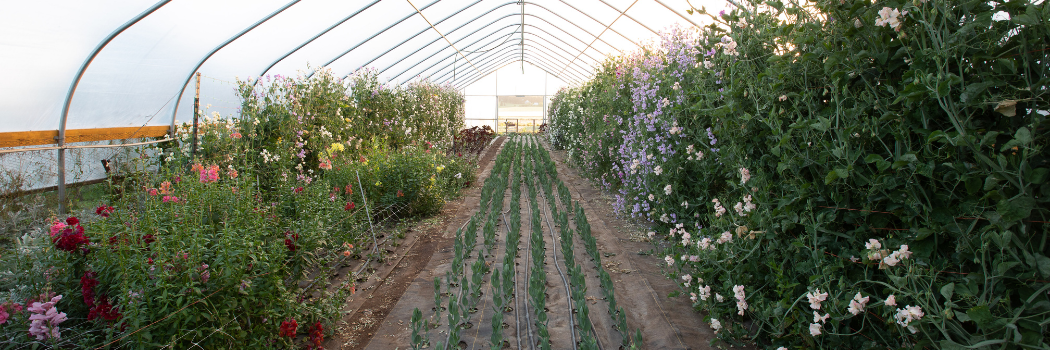
Above: High tunnel at Crowley House Flower Farm & Nursery in Rickreall, OR. Photo © Crowley House Flower Farm & Nursery.
By Debra Prinzing, Slow Flowers Society, April 2026

Crop planning can be challenging for small-scale flower farmers when space is limited. I asked several growers to share their strategies for crop planning in the greenhouse and high tunnel, including how to:
- Maximize growing space for higher yields and crop rotations
- Improve and maintain soil health
- Reduce pressure from pests and diseases
I reached out to five cut-flower farms to learn more. Part art and part science, crop planning can always benefit from fine-tuning, said the flower growers I interviewed.
- Crowley House Flower Farm & Nursery, Beth and Jayson Syphers and Keith Martin, (Zone 8b) in Rickreall, Oregon
- Everyday Flowers, Vivian Larson, (Zone 8b) in Stanwood, Washington
- Johnny’s Selected Seeds Research Farm, Joy Longfellow (Zone 5b) in Albion, Maine
- Mayfield’s Urban Garden, Christina Mayfield (Zone 8b) in Bremerton, Washington.
- The Painted Tulip, Nicole D’Agata, Waterbury Center, Vermont (Zone 4)
Rotating Crops Between 2 Unheated High Tunnels
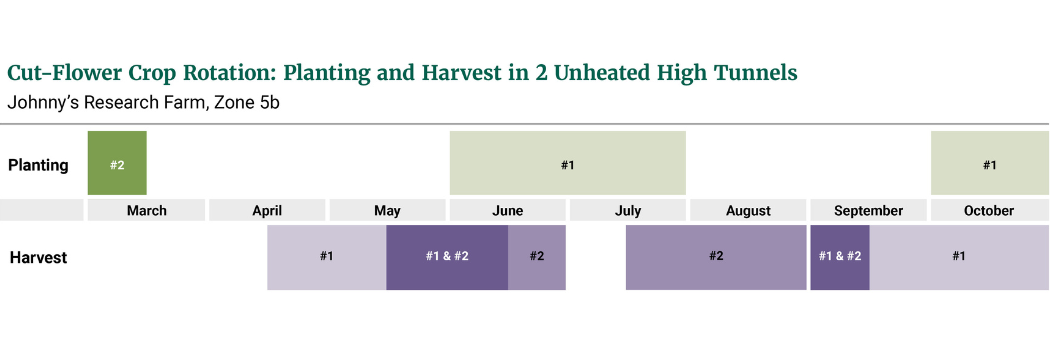
Joy Longfellow is the Flower Product Technician at Johnny’s Selected Seeds, managing the flower trialing program at the Johnny’s Research Farm. I asked Joy how she juggles space allocation and rotation in tunnel trials at the Research Farm in Albion, Maine (Zone 5b). “We’re growing many different crops and varieties in limited space within the tunnels; in that way it’s comparable to a typical flower farm,” she pointed out. Here’s a snapshot of how Joy pieces together a seasonal rotation to maximize the limited space.
Using two 30’ x 96‘ high tunnels allows for three distinct mini-seasons—fall-planted, spring-planted, and summer-planted.
High Tunnel #1
- Fall planted (spring and early summer harvest): The first tunnel is planted in October with cool-season flowers to be harvested from mid-April through June. Once harvest is finished, those beds are then flipped in late June to make way for summer-planted crops.
- Summer planted (fall harvest): Plantings made in June through early August flower in the fall (September and October), extending the growing season and providing a supply of high-quality blooms beyond the first frosts that can compromise open-field production. Both warm and cool-season crops are planted for fall harvest including celosia, marigold, zinnia, stock, snapdragon and dusty miller.
High Tunnel #2
- Early spring planted (spring and summer harvest): The second tunnel is planted in early March—as soon as the soil is warm enough. It often includes flower crops that won't reliably survive from a fall planting in Maine but which prefer an extended period of cool growing conditions, such as stock and ranunculus. These spring plantings will provide flowers from late May through June, supplementing the hardier, over-wintered flowers in the first tunnel. Lisianthus is another crop that is planted in the tunnel in early spring and will hold space in the tunnel through the summer, flowering from late July into early September. These spring-planted beds will be flipped in August-September to make way for the next year's fall-planted, over-wintered crops. Bringing the rotation back around to our October planting, above.
Rotating between two tunnels allows for enough time to flip beds between seasons, provides a brief period for the beds to rest between planting cycles and help interrupt cycles of pest and disease pressure.
Rotating Crops Between 3 High Tunnels
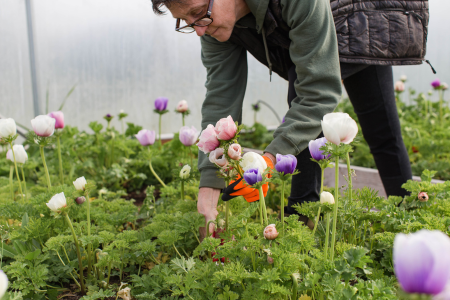
At Everyday Flowers (Zone 8b), Vivian Larson grows in raised beds placed within 26’ x 48’ unheated high tunnels. She rotates plantings between three high tunnels to ensure maximum yield. The raised beds are oriented perpendicularly on either side of a central aisle within the tunnels. This setup is important to protect crops from wet weather conditions. “The lisianthus, ranunculus, anemones and heirloom mums—they’re not fussy, but they don’t like wet! I could probably grow similarly in the ground with caterpillar tunnels, but the high tunnel setup gives me more control. Plus, we can get 2- to 3-degrees extra heat by having these crops in raised beds,” she added.
Vivian begins the year by planting one high tunnel with ranunculus and another with anemones in February. Her intensive planting philosophy—spacing corms every three inches rather than six inches as is sometimes recommended— doubles the harvest yield. Growing in the high tunnels also allows Vivian to tweak her harvest times, which means she often has ranunculus for Mother’s Day sales.
After the early spring specialty bulb crops are over, the anemone beds are “flipped” to lisianthus plugs and ranunculus beds are “flipped” to rooted mum cuttings. By the time the mum crops are finished in late November, it’s time to let the soil rest until February. This method of splitting the growing season into two cycles has paid off, Vivian said.
In a third high tunnel, she rotates sweet peas with more heirloom mums. “I always say, the first year’s crops pay for the high tunnel structure itself, plus the wood you purchased to build the raised beds and your soil. The next year, you start making money. But it’s not like a field that’s just there, because every few years, there will be more investments, just for the care and maintenance of the structure and the raised beds.”
Vivian suggests that smaller flower farms with only one high tunnel could adjust her methods and grow many more flower varieties than she does. “You could plant your whole summer of flowers in one tunnel with 14 raised beds,” she said, suggesting a mix of focal flowers and fillers that can be “flipped” for two succession plantings.
Rotating Crops Between High Tunnel & Field
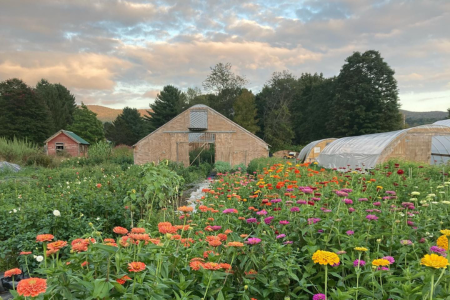
At The Painted Tulip, Nicole D’Agata rotates crops among high tunnel and field plantings. Photo © The Painted Tulip.
At Painted Tulip, Nicole D’Agata also relies on high tunnel production to extend the season. She uses a hybrid approach with tulip production—planting some bulbs in the high tunnel and others in the field. In her region, after a busy spring through Mother’s Day, lower demand from market customers occurs during July and August, often due to people in Vermont having their own cutting gardens. Things pick up again in late August into the fall months, especially with custom and DIY wedding orders, Nicole added. The spring-crop tunnel transitions into fall-crop tunnel for chrysanthemums. “We try to keep on a planting schedule and have everything all spread-sheeted out,” Nicole said. “But then obviously, life happens.”
In addition to the high tunnels, she maintains one large annual field, approximately 100-by-120 feet in size. Divided into two zones, “it is basically split it in half,” she explained. “Each year, the two areas are flipped, so wherever the annuals were, the dahlias go in; and then those sections rotate the following year.”
Rotating Crops on the Micro-Farm
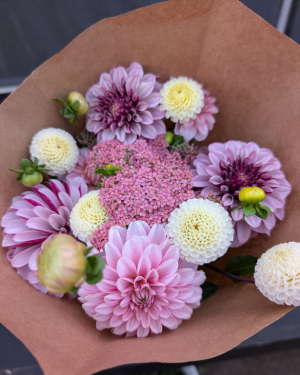
Mayfield’s Urban Garden is a micro-farm that produces enough flowers to supply CSA subscribers from early spring through fall; as well as a la carte wedding florals. Photo © Mayfield's Urban Garden.
The smallest-scale grower of my interviewees, Christina Mayfield of Mayfield’s Urban Garden (Zone 8b) grows on an 0.18-acre lot in a city neighborhood. She has 5 unheated, protected raised beds plus 20 bulb crates. This micro-farm produces enough flowers to supply CSA subscribers from early spring through fall; as well as a la carte wedding florals.
“Our planning begins in the fall and consists primarily of swapping crops out as the seasons change—as well as with intensive planting,” she said. In mid-November, Christina plants hundreds of tulips, daffodils, and alliums in crates lined with landscape fabric. In January, she begins winter and early-spring succession plantings—pre-sprouted ranunculus and anemones planted outdoors in raised beds under cover, and hardy annual seeds (snapdragons, rudbeckias, stock, and sweet peas) started in trays indoors to transplant out a few weeks before her last frost (usually around the beginning to mid-April). These plantings are followed by other successions of spring-flowering bulbs and starts of hardy annuals. By Mother’s Day, the spring bulbs are done blooming and come out of the crates. “At this point, we begin replacing them with our warm-season annuals that have been started indoors in trays in February—zinnias, cosmos, amaranth and celosia. “At the same time that I plant those starts, I also plant a second succession of zinnias and cosmos—directly sown in our raised beds,” Christina said.
Staggering Plantings with Seedlings, Plugs, and Root Cuttings
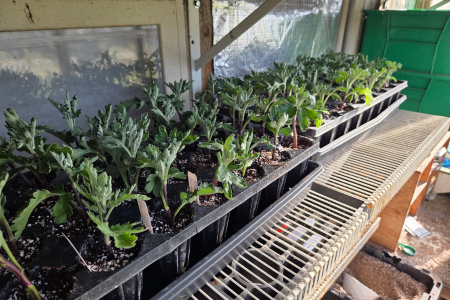
It is possible to make the most of limited growing space in part by starting plants using multiple methods, such as seed starting, planting from plugs (live plants purchased in), and rooted cuttings. A diversity of starting methods can help the grower to make the most of limited seed-starting space and growing space.
At The Painted Tulip, Nicole cultivates on a single acre, populated with two 30’ x 80’ high tunnels and a 17’ x 24’ propagation house. She also maintains a cold frame setup to house chrysanthemum cuttings. The year begins with anemones and ranunculus that are rooted indoors and then moved to the high tunnel, as well as stock and other cool flowers like bupleurum and snapdragons. By late June and into July when those spring crops are finished, Nicole plants rooted chrysanthemum cuttings, fall stock, and fall celosia seedlings. She uses a mix of seedlings and plugs, depending on availability and cost.
Everyday Flowers also uses some of these same strategies, growing lisianthus from plugs and mums from cuttings while starting other crops from seed.
Filling the Gaps
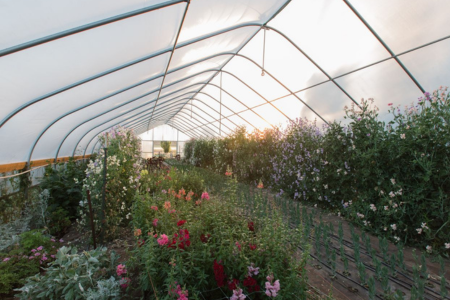
One challenge with small scale farming is that any given row inside the high tunnel is often planted with two or three different types of flowers. Photo © Crowley House Flower Farm & Nursery.
At Crowley House (Zone 8b), Jayson and Beth Syphers have several areas across three acres of production—under cover and in fields. Located near Salem, Oregon, Crowley House grows inside a 100’ x 30’ heated high tunnel with raised beds, as well as in raised beds outside that can be equipped with smaller caterpillar tunnels when protection is needed. Display gardens across the property inspire customers when they attend special events and workshops. “If something doesn’t sell through the flower farm, we’ll plant it in the display gardens or sell in the nursery,” Beth explained.
One challenge with small scale farming is that any given row inside the high tunnel is often planted with two or three different types of flowers. “While a big grower might have standardized 100’ rows that can be cut down and flipped at one time, we have one row that has everything from butterfly ranunculus to some poppies and pansies. It’s tricky to take one crop out and plant something new at one, because our variety of crops don’t necessarily end at the same time,” she pointed out.
More manual labor is required to sustain this situation, whereas a single-crop row might be easily flipped with mechanical solutions. If you haven’t planned ahead for the vacancy, you might find yourself without seedlings to install. “I have ended up direct-seeding when those gaps appear,” Beth added.
“If there are a few small sections in a row that maybe wasn’t calculated right, we try to have other starts available that can be popped in—sweet peas, snapdragons, ranunculus, anemones, and even a small batch of poppies,” Keith Martin added.
Small-Batch Cover Cropping in the High Tunnel
Larger farms have the luxury of being able to let sections “rest” from time to time, but smaller flower farms say they can’t always afford to do that. “We are asking so much from our soil, so that means really staying on top of amending it,” Beth (Crowley House) explains. When a crop might be struggling in the high tunnel, she will remove it and plant a cover crop in its place. “Cover crops grow fast in that environment, and we can still cut and till it under. Also, every time we rotate crops, we always go in and put down some blood meal or bone meal.”
By cover-cropping a single row, Crowley House ensures continual production. “It’s not like we can afford to have all the rows in an entire tunnel resting or in cover crops, like some people will do when they take a year off from planting a specific field,” she noted. “Since we are a shoulder-season farm, planting heavier in the spring, we might plant a few rows with cover crops during summertime.” One of her favorites is the organic Peas and Oats Mix.
Adding Compost for Soil Health
Crowley House also adds a lot of compost. We have that theory of “a good flower or a good plant starts in the soil,” Beth said. “Putting some money into our soil, especially in the high tunnel, means bringing in a ton of compost.”
At Everyday Flowers, Vivian said, “we amend the soil and we use a really good organic fertilizer; plus we add compost, because every time you take something out (such as removing spent bulb crops), you’re taking soil, too.” She starts with an organic three-way soil, custom mixed to her specifications. The ingredients include native soil, sand and a composted wood product. “We’re really careful to not have too much wood product, because in the long run, that means having to add more amendments to help it to break down.”
High Tunnel Pest & Disease Management
At Crowley House, the crops are moved annually—even from one row to the next—to reduce or prevent disease. Good record-keeping is important so that you also remember to change where a specific cultivar is planted from year to year, Beth advised.
Constant vigilance is required to manage potential pest and disease issues, especially in smaller growing spaces. At Everyday Flowers, Vivian regularly releases beneficial insects—ladybugs and lacewings, introduced in early spring. “Everything is concentrated in a greenhouse or high tunnel,” she points out. “If there are aphids, you’ve got to be on top of them right away. I try to use the predators. If I have to spray, I use organics, because I don’t want to kill my beneficiary insects. With mums, since we plant so close, there can be issues of powdery mildew, so we sometimes have to use copper sprays.”
Takeaways
Here are some farm-management steps you can take to improve the productivity of a small flower-growing operation.
- Look closely at the year’s calendar and begin mapping out cool-season crops and warm-season crops. Record-keeping is essential, especially so you can refer to past years’ performance of top-selling crops. When you know which flower crops command higher prices, build the schedule around those, filling in with essentials that you also need for bouquet-making ingredients. Or, devote unexpected openings of a row or section of a field to trialing new varieties.
- Develop a regular schedule for soil care. Plan ahead to add compost, mulch or organic amendments before each major seasonal planting. By investing in soil health for smaller areas, you’re setting up your crops to succeed.
- Consider small-batch cover cropping to ensure the soil isn’t left bare; or, try tarping to reduce weed pressure during down times.
- Although her priority is growing specialty cut flowers, Nicole points out that even flower farmers should feed themselves. “I always save a food spot in the middle section of my tunnel for winter kale, spinach, beets, and carrots.”
Learn More
- 5 Cool Flowers to Plant Now • Lisa Mason Ziegler's Secrets for Growing Hardy, Cool-Season Annuals • Article
- Part 1: Introduction to Overwintering Flowers: Methods & Recommendations from Johnny’s Multiyear Trials• Article
- Part 1: Introduction to Forcing Flower Bulbs in Soil• Article
- Succession Planting for Cut Flowers • Your Seed Chronicles: Planning & Planting for an Abundant & Frequent Floral Harvest • Article
- Succession Planting • Methods for Providing a Continuous Supply • Article
- Succession Planting • Interval Chart for Flowers • CHART
- Succession Planting • Recommended Flowers • Table